
The Success of Small Business Events
The Success of Small Business Events Through Reception and Hospitality Logistics
At the heart of Saudi Arabia’s economic transformation, an event is no longer just a fleeting gathering or a product launch; it has become a tangible embodiment of a business’s corporate identity. For small and medium-sized enterprises (SMEs), an event represents the most critical and impactful opportunity. It can either build a bridge of lasting trust with the customer or leave a lasting impression of disorganization.
The fundamental difference between a successful event and one that goes unnoticed lies in the “hidden logistics.” This logistics is not simply providing chairs or serving coffee; it is a comprehensive engineering of the customer journey from the moment they receive the invitation until they arrive home after the event. In this article, we will delve deeply into the details of reception and hospitality as strategic tools for growth in the Saudi market.
Chapter One: The Psychology of Reception in Saudi Culture
The Saudi public possesses a high level of awareness and refined taste regarding courtesy and hospitality. In our culture, a reception is not merely an administrative procedure, but a welcoming message that establishes the guest’s standing with the host.
Digital Welcome
Logistics begin at least a week before the event. A smart small business uses a “proactive welcome”:
- Logistic Confirmation: Sending a text message (SMS) or WhatsApp message 24 hours before the event, containing not only a reminder of the time but also a precise “location map” and parking directions. This kind of attention reduces visitor anxiety before arrival.
- Digital Seamlessness: Using QR codes for registration at the entrance gives the business a “tech-professional” edge, aligning with the Kingdom’s digital transformation goals.
Reception Team: Brand Ambassadors
Small businesses often entrust reception to untrained staff or volunteers. This is a serious mistake. The reception team must master body language, a genuine smile, eye contact, and a confident posture.
Chapter Two: Flow Engineering and Spatial Logistics
Space in small businesses is often limited, and this is where the genius of logistical organization shines through in transforming “confinement” into “organized intimacy.”
The “Three Stations” Theory
To prevent visitors from congregating in one area, the event should be logistically distributed across three main stations:
- Reception and Registration Station: This should be at least two meters away from the door to avoid congestion at the entrance.
- Experience Zone (Heart of the Event): This is where the product or service is showcased and should be located at the widest point of the venue.
- Hospitality and Networking Corner: Ideally located further back, this should encourage visitors to experience all aspects of the event before accessing hospitality.
The “Focus on Experience” Approach
- Ambient Environment Design: The quality of the climate and acoustic environment is the “sensory comfort” that underpins visitor satisfaction. It’s impossible for a client to focus on your event’s content if they are experiencing poor cooling or distracting noise.
- Climate Management: In the Kingdom’s environment, the air conditioning system is the “backbone” of the venue’s logistics. It’s essential to test the cooling systems and ensure they reach the ideal temperature at least five hours before the event begins to guarantee a stable atmosphere regardless of the number of attendees.
- Auditory Balance: Sound effects should serve the event’s objectives, not detract from them. Choose calming tones that allow for smooth conversation in formal meetings, and make them more lively for launch parties, always ensuring the volume remains at a supportive level, not a disruptive one.
Chapter Three: The Art of Saudi Hospitality: Transforming Obligation into a Strategic Tool
In the Saudi market, hospitality is a mirror reflecting a project’s values and seriousness. For startups, hospitality is not merely a cost item, but the true test of building rapport with the client. It offers an opportunity to deliver a luxurious experience that breaks down barriers of formality, even on a limited budget.
The Saudi Coffee Protocol: Symbolism of Value and Connection
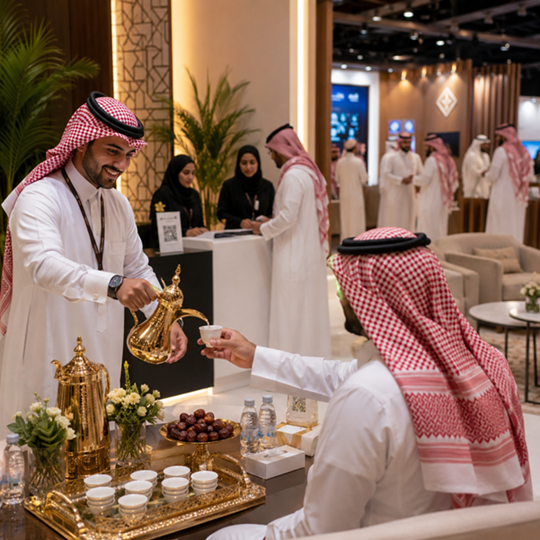
At our events, coffee transcends being just a “welcome drink”; it’s a national protocol that embodies a language of mutual respect. The success of this logistical element depends on two essential details:
- Quality Standards and Superior Preparation: The impression of your project begins with the “top of the cup.” Therefore, the coffee must be authentic, light-roasted, perfectly balanced with cardamom and saffron, and served at the ideal temperature. Any negligence regarding the cleanliness of the utensils or serving cold coffee is a logistical blunder that can give the impression of a lack of attention to detail, which may negatively impact the image of your core product’s quality.
- Hospitality Ambassadors (Live): The person serving the coffee is truly an ambassador for your brand. It is essential that the team masters the art of traditional serving, starting with holding the coffee pot in the left hand and the cups in the right, adhering to the right-hand serving method, and being vigilant in keeping the coffee pot warm throughout the event to ensure a continuous experience of hospitality for every guest who enters the venue.
Innovation in Finger Food
Instead of large, expensive buffets that cause logistical chaos, opt for “packaged hospitality” or “luxury bites.” Focus on smart packaging by offering stuffed dates or small sweets in containers bearing your business logo. This makes it easy for guests to enjoy while browsing and reduces the need for large seating areas.
Chapter Four: Technical Logistics and Enhancing Digital Reach
A successful event is one that is seen by those who didn’t attend.
Setting Up an Instagrammable Logistic
At least one area within the event should be designed to be a “camera hotspot”:
- Lighting: Provide ring lights or hidden studio lighting to ensure visitor photos look professional.
- Backdrop: A simple and elegant backdrop displaying the project logo and event hashtag in an unobtrusive way.
Power and Charging Logistics
At events lasting more than two hours, a phone charger becomes more expensive than a cup of coffee. Providing a small charging station or portable power banks for visitors is a logistical gesture that customers won’t forget and will encourage them to stay longer.
Chapter Five: Managing Logistical Crises (Contingency Plan)
Small businesses thrive when they anticipate and prepare for potential failures, such as dealing with a sudden surge in attendance. What if 100 people show up when you’ve only invited 50?
- Backup Stock: Always maintain a 20% surplus of refreshments and souvenirs.
- Live Support Team: Have staff on standby who can be called upon immediately to assist with organization.
Gracious Exit Logistics
The logistics end at the exit. Offer:
- A Farewell Gift: Something simple (a product sample, a handwritten thank-you card, an exclusive discount code).
- Assistance with Transportation: Ensure someone is at the exit to help visitors find their vehicles or direct them to ride-hailing app pick-up points.
Chapter Six: Measuring Logistical Success (Post-Event)
The event doesn’t end when the last guest leaves; it’s the beginning of the “logistical harvest.”
Data Analysis
How many people registered? How many actually attended? What was the point at which visitors spent the most time? This data fuels your next event.
Follow-up Communication
Sending a thank-you message the following day, along with a link to photos from the event, strengthens the relationship and transforms a visitor from a potential customer into a loyal brand advocate.
Read also: Event Planning Strategy for Small Businesses
Conclusion:
The success of small business events in Saudi Arabia no longer depends on budget size, but rather on meticulous attention to logistical details and respect for local hospitality culture. When you master the “hidden supply chains” of reception and hospitality, you’re not just organizing an event, but building a sophisticated and professional corporate reputation.
Always remember: the product may be forgotten, but the feeling of appreciation that overwhelmed the visitor during his reception and hospitality will remain engraved in his memory, and it is the real driver of the next purchase decision.


Comments