
Logistical Challenges for International Delegations
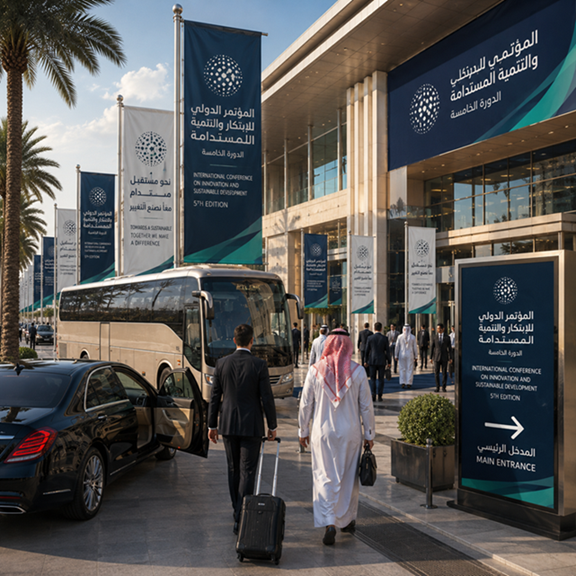
Logistical Challenges for International Delegations on Saudi Arabia’s Transportation Network
The Kingdom of Saudi Arabia is witnessing an unprecedented surge in hosting international events, including political and economic conferences, global sporting and entertainment events, and the Hajj and Umrah pilgrimages, which bring together millions of people in a specific geographical area and within a record timeframe. This massive influx, driven by the objectives of Saudi Vision 2030, puts the transportation sector’s logistics system to the ultimate test.
Official and business delegations face diverse and complex logistical challenges when navigating the Kingdom’s transportation network. Managing these movements involves more than just providing transportation; it also encompasses security considerations, diplomatic protocol, time efficiency, and technological integration. These challenges can directly and decisively impact the efficiency of delegations, the effectiveness of their participation, and their perception of the Kingdom’s investment and regulatory environment.
Coordinating Transportation for Large Groups
Coordinating transportation for large groups and multinational delegations is one of the most complex logistical tasks. When a delegation comprises dozens or hundreds of members, organizers strive to balance flexibility of movement with adherence to a unified schedule.
Dedicated Transportation and Professional Services Requirements
International delegates and officials often require dedicated transportation services to facilitate their movement between accommodations, conference centers, and side meetings. In major, economically vibrant cities like Riyadh and Jeddah, using professional and chartered group transportation services (such as dedicated luxury buses and executive chauffeur-driven cars) becomes essential.
- Avoiding Wasted Time: Relying on individual or haphazard transportation leads to delegation members being scattered and time being wasted coordinating meeting points.
- Managing Peak Periods: Precise scheduling and strict adherence to schedules are crucial during peak periods, as demand for vehicles and drivers increases due to overlapping events in the capital or other major cities.
- Diplomatic Protocol: High-level delegations require specific vehicle classifications (executive and luxury vans) and drivers trained in handling VIPs and familiar with diplomatic etiquette and protocol.
Challenges of Accessibility and Traffic Environment
Accessing key locations and vital facilities on time is a constant challenge in major Saudi cities due to rapid urban development and massive infrastructure projects.
Urban Traffic Dynamics
Traffic conditions in Saudi cities are characterized by rapid fluctuations. Morning and evening rush hours, or even minor accidents, can lead to severe traffic congestion that impedes the movement of delegations.
Special Access Barriers and Fees
Many vital locations (such as international conference centers, diplomatic areas, or airports) impose special access requirements, including:
- Prior security clearances: for vehicles and drivers to enter restricted areas.
- Smart toll gates: or parking and congestion fees that must be factored into logistical budgets.
- Checkpoints: which can cause unexpected delays if not coordinated with the relevant security authorities.
A lack of familiarity among organizers or drivers with local traffic patterns and restricted times for certain types of vehicles (such as prohibiting large buses from entering certain streets at specific times) reduces the efficiency of the trip. Therefore, it is essential that the logistics planner has a comprehensive understanding of alternative routes and secondary entry and exit points.
Group Size and Travel Arrangement Architecture
The complexity of logistical arrangements is directly proportional to the size of the international delegation. Large groups, particularly those with 12 or more members, move beyond simple management and into the realm of “logistical architecture” for transportation.
Strategies for Managing Large Groups
To ensure that all delegation members arrive at their destinations simultaneously, logistics teams should adopt the following solutions:
- Multiple Identical Vehicles: Using fleets of cars or minibuses to ensure convenient distribution of members.
- Staggered Shuttles: Operating periodic shuttles at fixed intervals (e.g., every 15 minutes) to ensure smooth movement and prevent overcrowding at hotel or venue entrances.
- Mini Operations Rooms: Drivers and supervisors are connected via a unified communication system (wireless system or live tracking applications) to monitor movements in real time.
Luggage Logistics and Special Needs
Many organizations overlook the space required for delegations’ luggage and equipment (such as display screens, official documents, or diplomatic gifts). This necessitates the allocation of separate luggage vans to ensure comfortable space for passengers on main buses. The “universal accessibility” needs of delegation members with mobility impairments must also be considered, with vehicles equipped with hydraulic lifts and wheelchair access.
Read also: Vehicle Types for Different Events
The “Last-Mile Connectivity” Challenge
The “last-mile” is one of the most critical and bottleneck-like links in the logistics chain. It refers to the process of transporting the delegation from the main transportation hub (such as airports and high-speed train stations) to the precise final destination (such as the hotel entrance or a meeting room within a large government complex).
Challenges and Proposed Solutions
When an international delegation arrives at King Khalid International Airport in Riyadh or King Abdulaziz International Airport in Jeddah, the transfer from the departure terminal to the vehicle can be time-consuming due to customs procedures and passport control. After exiting the terminal, the challenge of efficient connectivity arises:
This last challenge is a significant one: Congestion at airport exit gates. A sustainable logistical solution lies in allocating dedicated VIP lounges and expedited exit routes in coordination with airport authorities.
Other common challenges include the dispersed locations and difficult access to internal buildings. A helpful solution is providing feeder buses and electric golf carts for internal transportation.
Effective integration between private transportation and existing public systems ensures reduced waiting times and a smooth, stress-free travel experience for international delegations.
Religious Logistics: Transporting Pilgrims as a Global Model
The Kingdom of Saudi Arabia possesses a unique global characteristic: managing and transporting millions of people during the Hajj and Umrah seasons. This unique experience represents the largest logistical transportation challenge on Earth, as international delegations from more than 160 countries converge simultaneously on a limited geographical area (Mecca, Medina, and the Holy Sites).
Specialized Transportation System
The Kingdom relies on specialized and classified land transportation companies that are subject to strict oversight by the Ministry of Hajj and Umrah and the Public Transport Authority. This system includes:
- Modern Bus Fleets: Advanced, fully air-conditioned buses equipped with GPS tracking technology to ensure the comfort of pilgrims traveling long distances between cities (such as the Jeddah-Makkah-Madinah route).
- Professional Drivers and Road Safety: Driving on busy Hajj routes and in the holy sites (Mina, Arafat, Muzdalifah) requires qualified and experienced drivers with thorough knowledge of side roads, restricted areas, and traffic control points to ensure the safety of lives and adherence to the strict crowd management schedules set by the authorities to prevent overcrowding.
- The Haramain High-Speed Railway: This railway has revolutionized logistics by connecting Makkah, Madinah, Jeddah, and the airport, significantly reducing travel time and providing a highly efficient option for international Islamic delegations.
Transportation Services to and from Airports and Major Events
Airport reception and departure services are the first and last impression that international delegations form of the host country’s efficiency. Therefore, designing these services requires meticulous precision.
Tailored Solutions
Destination Management Companies (DMCs) and logistics providers in the Kingdom offer customized solutions tailored to the nature of the travel and the size of the group:
- For individual travelers and small delegations: Luxury sedans with multilingual drivers are provided, along with live tracking by organizers to ensure the guests’ safety and arrival.
- For large delegations (large weddings, political conferences, trade shows): Field teams are deployed at airports to greet guests and guide them to their designated buses based on identification badges and real-time passenger manifests.
These integrated solutions offer travelers a comfortable travel experience, alleviating the stress of long journeys and eliminating the hassle of searching for transportation in crowded airports or getting lost in unfamiliar traffic patterns.
Technology and Innovation in Overcoming Logistical Challenges
Traditional paper-based management and manual schedules are no longer sufficient to address the challenges of transporting international delegations in the Kingdom. The sector is now strongly moving towards adopting advanced technological solutions to enhance efficiency:
- Intelligent Transportation Systems (ITS): Using artificial intelligence software to predict traffic congestion and adjust bus routes in real time.
- Centralized Booking and Control Platforms: Enabling organizers to monitor the entire fleet from a single screen, detect any delays or route deviations, and address them immediately.
Conclusion
The success of international delegation movements in Saudi Arabia depends on proactive and thorough planning of every logistical detail. Despite the Kingdom’s impressive infrastructure and massive investments in the transportation sector, the dynamic nature of cities and the size of crowds still demand highly skilled management.
For successful delegation movements with the highest standards of efficiency, the following is recommended:
- Early contracting: With professional, locally accredited transportation companies that have a proven track record of success in managing major events.
- Conducting route reconnaissance: Several days before the event to identify traffic diversions or ongoing projects.
- Joint coordination: With relevant government and security agencies to obtain permits and facilitate passage through checkpoints and sensitive areas.
By adopting these integrated strategies, logistical challenges can be transformed into opportunities to deliver an exceptional experience that reflects the bright, civilized image of the Kingdom of Saudi Arabia to the international community. Learn about the chauffeur-driven and chauffeur-driven car rental service offered by Alwofod Establishment.


Comments