
Preparing a Comprehensive Itinerary for a First-Time Business Delegation
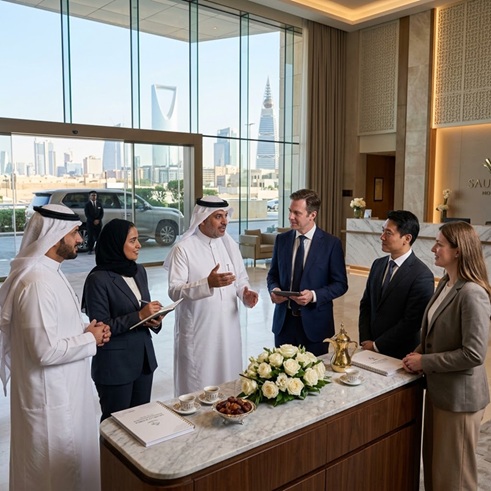
Guide to Preparing a Comprehensive Itinerary for a First-Time Business Delegation Visit to Saudi Arabia
A business delegation visit to the Kingdom of Saudi Arabia presents a significant opportunity to build new relationships, explore investment prospects, and establish partnerships and agreements that pave the way for long-term collaboration. However, the visit’s success depends not only on the quality of the meetings but also on meticulous planning regarding every surrounding detail—from airport reception, hotel selection, and transportation arrangements to dining choices and tourism activities.
For a delegation visiting Saudi Arabia for the first time, a well-structured, comprehensive itinerary ensures the visit is as productive as possible. It provides guests with a professional experience that reflects positively on the company, the host organization, and the Kingdom itself as a premier destination for business and investment. This guide outlines the key elements to consider when planning a business delegation visit to Saudi Arabia.
First: Defining the Visit’s Objectives Before Planning the Itinerary
Before booking hotels or scheduling meetings, the primary objective of the delegation’s visit must be clearly defined. Is the goal to gain insight into the Saudi market? To seek business partners? To meet with investors? To tour existing facilities and projects? Or to negotiate an agreement or contract?
Defining the objective helps structure the itinerary logically, ensuring that every activity serves the visit’s main purpose. If the delegation includes investors, time can be allocated for meetings with relevant entities and companies, alongside site visits to specific projects. Conversely, if the delegation is seeking distributors or business partners, priority should be given to one-on-one meetings and professional networking sessions. It is also essential to know the number of delegation members, their positions and nationalities, their arrival and departure times, and the duration of their stay in the Kingdom. This information forms the foundation upon which the entire program is built.
Read also: Investment Delegation Services in the Kingdom
Second: Preparing a Realistic Meeting Schedule
The meeting schedule is a crucial component of the trade delegation program and requires meticulous planning. A common mistake is attempting to cram as many meetings as possible into a single day, leading to time pressure and causing the delegation to fall behind schedule. It is best to arrange meetings based on geographical location and the duration of each session, while allowing for a buffer between appointments to account for traffic or unexpected delays.
For instance, the morning could be dedicated to formal meetings, followed by a break and lunch for the delegation, with an afternoon meeting or site visit scheduled thereafter.
Understanding the nature of each meeting in advance is also important. An introductory meeting may require less time than a session dedicated to contract negotiations or discussions regarding an investment partnership. Furthermore, it is advisable to share the visit schedule with delegation members and host entities beforehand, clearly outlining meeting locations, times, and the names of participants. The program should not be overly rigid; incorporating buffer time allows for adjustments should a meeting run long or a new opportunity arise to meet with a key stakeholder.
Third: Selecting Suitable Accommodation for the Delegation
Choosing a hotel should not depend solely on its star rating or luxury level, but also on its location and suitability for the visit schedule. If the majority of meetings are concentrated in a specific area, it is best to select a hotel nearby to minimize travel time. If meetings are spread across multiple areas, the chosen location must offer convenient access to the key venues included in the itinerary.
Other factors to consider include the level of privacy, room quality, the availability of meeting rooms as needed, on-site dining options, business services, and a seamless check-in/check-out process. It is also essential to verify booking details—such as the number and type of rooms, arrival and departure times, and any special guest requirements—prior to the delegation’s arrival.
For executive delegations, designating a space within the hotel for informal meetings can be beneficial; this saves time and allows for quick discussions outside of formal sessions.
Fourth: Planning Transportation Between Appointments
Transportation is a crucial element in the success of any business delegation visit, particularly in large cities where travel times between locations can vary significantly depending on traffic and meeting schedules. Therefore, a clear transportation plan must be established from the outset, detailing the mode of transport, the number of vehicles required, travel routes, and departure and arrival times.
The choice of transportation depends on the size of the delegation and the nature of the visit. Executive cars may be suitable for small delegations or senior officials, whereas larger vehicles are appropriate for groups with a greater number of participants.
Ideally, delegation members should not have to wait until a meeting concludes to find out about their next mode of transport; the vehicle and driver should be waiting at the pre-arranged time and location. Furthermore, the itinerary should include buffer times for travel rather than relying solely on theoretical travel duration estimates. A successful itinerary is one that can accommodate unforeseen circumstances without disrupting the core meetings.
Read also: Innovative ideas for planning event guest transportation
Fifth: Selecting restaurants for the delegation’s itinerary
Lunch and dinner are not merely breaks; they can be a significant part of the delegation’s experience and a means to build business relationships. When selecting restaurants, consider the location relative to the hotel or the next scheduled meeting, as well as the nature of the delegation and the members’ dietary and cultural preferences.
It is beneficial to choose a variety of restaurants rather than relying on a single type of cuisine throughout the visit. The itinerary could include opportunities to sample local cuisine alongside international dining options that suit the guests’ tastes.
Regarding meetings held over a meal, it is preferable to choose a restaurant that offers an appropriate level of privacy and quiet—especially if the discussions involve business information or important negotiations. Reservations should be made in advance, informing the restaurant of the number of guests, arrival time, and any special dietary requirements to avoid delays or confusion upon arrival.
Sixth: Incorporating Tourism and Cultural Visits
A business delegation’s visit to Saudi Arabia need not consist solely of a continuous series of meetings. Allocating time to explore the Kingdom, its culture, and its landmarks can make the experience more memorable and help guests form a positive impression of the country. However, the choice of tourism activities should align with the nature of the delegation and the duration of their stay. A delegation staying for only two days requires a concise, well-planned itinerary, whereas a delegation staying for a week can dedicate more time to cultural and leisure activities.
Options include visiting historical or cultural landmarks, touring a heritage district, or participating in tourism activities available in the host city. It is best to schedule such visits at the end of a light workday or during a time separate from critical meetings, ensuring they do not distract delegation members or interfere with their business commitments.
Seventh: Considering the Delegation’s Culture and Composition
There is no single itinerary that suits every delegation. The needs of a delegation comprising senior investors differ from those of a group of sales managers, engineers, or representatives from various companies. Therefore, it is essential to familiarize yourself beforehand with the guests’ culture, approximate ages, professional backgrounds, dietary preferences, and the visit style that suits them best.
Cultural nuances regarding how guests are welcomed, as well as the management of meetings, schedules, and hospitality, must also be taken into account. Small details can significantly influence the impression guests form of the visit.
Eighth: Preparing a Contingency Plan
Even the most well-organized itineraries can face unexpected changes. A flight might be delayed, a meeting could run over time, or a participant might need to reschedule an appointment. For this reason, a contingency plan should be prepared for key elements of the program—particularly transportation, meetings, and dining arrangements. Having ready-made alternatives minimizes confusion when changes occur and enables the organizers to handle emergencies swiftly without compromising the delegation’s experience.


Comments