
How to Protect Your Guests from Attendee Fatigue at Multi-Day Conferences
How to Protect Your Guests from Attendee Fatigue at Multi-Day Conferences
On the first day, a guest enters the conference hall with great enthusiasm. By the afternoon of the second day, however, questions begin to arise: “When is the break?” “Where can I find a quiet spot?” and “Is there anything left worth attending?” This is “attendee fatigue”—one of the greatest risks to the success of any conference spanning more than one day. An exhausted guest will not engage with the content, will not build professional relationships, and is unlikely to return for future editions.
The responsibility does not lie solely with the guest. The organizer—who designs the program, the venue, and the hospitality—is best positioned to prevent fatigue before it even sets in. In this guide, we explain how professional event management companies address this challenge, covering everything from program design and prayer times to hospitality and guest flow.
Why should an organizer care about attendee fatigue?
Guest fatigue directly impacts an event’s outcomes. Exhausted attendees often skip the final sessions, visits to sponsors and exhibitors drop off on the last day, and satisfaction survey results fall short of expectations—even when the speakers are excellent. Conversely, a conference that sustains its guests’ energy levels delivers a higher return on investment, generates positive word-of-mouth, and becomes an event the market looks forward to every year. With the rapid growth of conferences and exhibitions in Riyadh, Jeddah, and Dammam, the guest experience has become a true differentiator between one event and another.
Read also: Protecting Delegate Privacy by Ensuring the Confidentiality of Information and Data
Design a Program with a Pace That Respects Attendee Energy
The first step is to abandon the idea of filling every single minute with a session. The brain requires breaks to process what it has heard. Experienced event teams often employ the following practices:
- Shorter sessions: Breaking content into 30- to 45-minute segments, rather than holding long, continuous lectures.
- Substantial breaks: Providing breaks of at least 15 minutes between sessions—far more than the mere five minutes typically spent moving between rooms.
- Graduated intensity: Starting with an intensive first day, incorporating a mix of interactive workshops on the second day, and concluding with a lighter final day that ends early and provides clear takeaways.
- Parallel tracks: Offering attendees the freedom to choose sessions that best suit their interests, rather than compelling them to attend everything.
- Varied formats: Blending lectures with discussions, workshops, and short presentations to ensure the day does not consist solely of sitting for long periods.
Integrating prayer times into the event schedule
A defining feature of organizing events in the Kingdom is that prayer times establish a natural, consistent rhythm. A savvy organizer transforms these moments into opportunities for rest. This means structuring the schedule so that no session overlaps with the *adhan* (call to prayer), and ensuring that clean, air-conditioned prayer spaces—with adequate facilities for *wudu* (ablution)—are readily accessible for both men and women. It also involves allocating ample time before and after prayers, so attendees do not feel rushed. When guests perceive that the program respects both their religious observances and their need for rest, their confidence in the organizer grows, and their overall experience is significantly enhanced.
Thoughtful Saudi hospitality
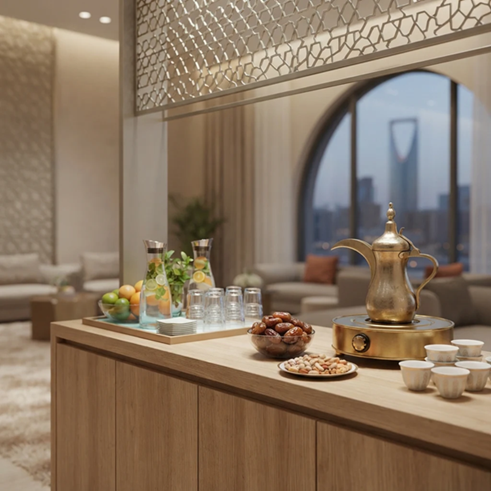
While coffee and dates are quintessential elements of Saudi hospitality, an overabundance of sweets and pastries—followed by a heavy lunch—often leads to lethargy during the afternoon hours. Professional teams strike a balance between authenticity and wellness by providing:
- Coffee and date stations, distributed across multiple locations to prevent crowding.
- Clearly marked, accessible water stations throughout the day—essential, as dehydration is a hidden cause of fatigue in air-conditioned environments.
- Light, nutritious snacks—such as protein-rich items, nuts, and fruits—alongside traditional offerings.
- A balanced lunch that avoids becoming an overly heavy meal, including vegetarian options and dishes free from common allergens.
- Consideration for those fasting or with specific dietary requirements, particularly when a conference coincides with fasting periods.
Designing the Venue and Guest Flow
Much of the fatigue experienced at events stems from walking and waiting, rather than the content itself. Large conference centers are expansive, and guests may end up walking thousands of steps just to move between halls. Consequently, planning begins with location selection: choosing a hotel near the venue, providing scheduled shuttle services, ensuring organized parking, and installing clear signage. Inside the halls, comfortable seating is provided, and air conditioning is set to a moderate, pleasant temperature. Quiet zones, removed from the noise, are designated for guests to regain their focus. Furthermore, the needs of the elderly and people with disabilities are addressed through accessible pathways and well-adapted facilities.
Read also: How to Choose the Right Exhibition Organizing Company
Leveraging Technology to Ease the Burden
Effective technology should reduce effort, not increase it. One of its most prominent tools is a conference app that displays a personalized schedule for each guest, enables quick check-in via QR codes—eliminating the need for queues—sends brief notifications about upcoming sessions or room changes, and provides access to session recordings for those who may have missed a talk, ensuring they don’t feel any regret. This offers guests genuine flexibility: they can attend what matters most to them, take a break when needed, and revisit the content later.
Transform networking into an organized and calm experience
Professional networking is a primary objective of conferences, yet it can become socially exhausting if left to chance. To address this, professional teams organize guided interactions that connect guests based on shared interests, set up comfortable networking lounges, and schedule dedicated time slots for brief, pre-arranged meetings. As a result, guests walk away with a few high-quality, meaningful connections, rather than having to endure hundreds of draining handshakes.
Choose the right timing for the event
The timing of a conference has a greater impact on energy levels than many realize. Holding an event during the peak of summer heat makes travel more arduous, while scheduling it during holidays or major seasonal periods can lead to lower attendance and higher accommodation costs. During the month of Ramadan, the entire programming philosophy must shift—starting earlier and concluding before Iftar, or taking place in the evening with a lighter schedule that accommodates those who are fasting. Every conference requires a careful review of the city’s calendar before a date is finalized.
Monitor signs of fatigue and make adjustments during the event
A skilled organizer does not wait for the final post-event survey. Instead, they track real-time indicators—such as comparing attendance levels between morning and evening sessions. Which sessions do guests leave early? And what do the brief, in-app surveys reveal? Based on these insights, you can extend a break, reschedule a session, or add a hospitality station—addressing issues before they escalate into formal complaints.
How can AL Wofod help you protect your guests?
AL Wofod is a Saudi organization specializing in the coordination of conferences, exhibitions, meetings, and delegation visits. We provide comprehensive support for guests from the moment they arrive until their departure, including flight and hotel bookings, airport meet-and-greet services, vehicle rentals (with or without a driver), meeting venue arrangements, restaurant reservations, catering services, and local transportation within the Kingdom. By consolidating all these details, we ensure your guests arrive at your event feeling refreshed and remain energized right through to the final session.
Frequently Asked Questions About Attendee Fatigue at Conferences
What is the ideal duration for a multi-day conference?
It depends on the audience and the content; however, many conferences achieve the best results over two to three days, with a higher intensity at the beginning that tapers off by the final day. More important than the number of days is the quality of the rhythm between sessions and breaks.
How long should breaks between sessions be?
Ideally, breaks should be at least fifteen minutes long, with extended time allocated for prayer and lunch, allowing guests to move around, enjoy hospitality, and network without feeling rushed.
Is it possible to reduce fatigue without decreasing the number of sessions?
Yes—by offering parallel tracks, session recordings, and a dedicated mobile app, guests can choose what suits them best, rather than feeling obligated to attend every single session.
Conclusion
Attendee fatigue is not an inevitable consequence of long conferences; rather, it is the result of organizational choices that can be improved. This includes creating a well-paced agenda, a schedule that respects prayer times, thoughtful hospitality, a comfortable venue, technology that eases the burden, structured networking opportunities, carefully considered timing, and continuous on-site coordination. When these elements come together, guests leave with actionable ideas and a positive impression that encourages them to return. Are you planning an upcoming conference? Reach out to AL Wofod, and let us design an experience that sustains your guests’ energy from the very first session to the last.


Comments