
Contingency Planning for Delegations
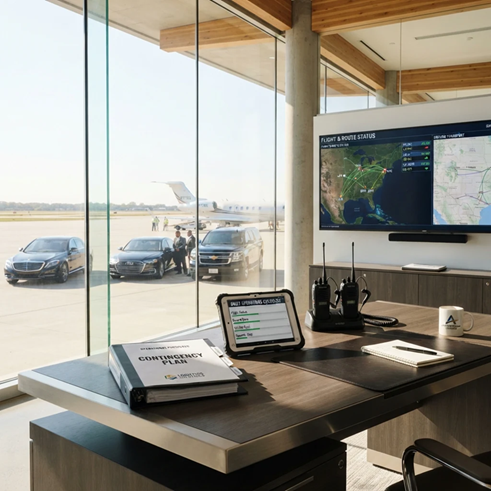
Contingency Planning for Delegations: Fundamentals and Ensuring Effective Implementation
The competence of a delegation coordinator is best measured by how they handle situations when things do not go according to plan—whether it is a delayed flight, a vehicle breakdown in heavy traffic, a guest’s sudden health issue, or a dust storm that forces a complete change to the day’s itinerary. In a country that hosts official, commercial, athletic, and religious delegations throughout the year, a contingency plan is no longer an optional addendum to a visit’s documentation; it has become an essential component of the service quality itself.
Delegations may not always recall that everything went smoothly, but they will certainly remember how the first unexpected problem was handled. In this article, we outline the fundamentals required for any coordinator to develop a practical contingency plan, and then address the more challenging question: how can we ensure that the plan is actually implemented, rather than remaining merely a document tucked away in an office drawer?
What is a contingency plan for delegation visits?
It is a practical, written document that answers four key questions: What might happen? Who is responsible for taking action? What are the specific steps to follow? And what resources or alternatives are immediately available? Unlike the primary itinerary—which outlines the intended course of events—a contingency plan describes the actions to be taken when things deviate from that course.
It is important to distinguish between two levels of incidents. The first level involves operational disruptions—such as a delayed flight, severe traffic congestion, or a vehicle breakdown—which are typically managed using pre-prepared alternatives. The second level concerns critical situations—such as an accident, a serious medical emergency, or a security issue—which require rapid decision-making and coordination with official authorities.
Step One: Identifying and Prioritizing Risks
You cannot develop an effective plan without first understanding what it is intended to address. Begin with a brief session with your team to ask: “Where could this visit go wrong?” Then, categorize these risks into clear groups:
- Travel and Transportation: Flight delays or cancellations, lost luggage, vehicle breakdowns, or traffic congestion during peak hours.
- Health: Sudden illnesses, heat exhaustion, pre-existing chronic conditions among delegation members, or food allergies.
- Weather and Environment: Extreme summer heat, dust storms, or heavy rain and flash floods (depending on the region and season).
- Accommodation and Hospitality: Booking issues, hotel facility failures, or unexpected changes in the number of guests.
- Documentation and Procedures: Lost passports or documents, procedural delays, or errors in booking information.
- Technology and Communication: Internet outages, booking system failures, or loss of contact with the team.
- Suppliers: Unexpected cancellations or delays by service providers.
Next, evaluate each risk based on its likelihood and potential impact, then rank them. The goal is not to account for every conceivable scenario, but to focus on risks that combine a high probability of occurrence with a significant impact—these are the ones that should take priority in your plan.
Step Two: Clearly Defining Roles
During a crisis, nothing causes more confusion within a team than the question: “Who makes the decision?” Therefore, your plan must explicitly name the individuals—not just their job titles—assigned to the following roles:
- Visit Leader or Emergency Manager: The person with final decision-making authority in critical situations.
- Communication Officer: The individual who serves as the single point of contact with the head of the delegation and the host entities, ensuring a unified voice and consistent messaging.
- Logistics and Transportation Officer: Responsible for maintaining ready-to-use alternatives for vehicles, routes, and travel itineraries.
- Health and Safety Officer: Coordinates with medical facilities and monitors the well-being of the delegation.
- Delegation Escort: The primary point of contact for the guests, acting in accordance with the leader’s instructions.
For every role, a designated alternate must be assigned, as a crisis could arise precisely when the primary person in that role is unavailable. Additionally, the plan should include a communication tree—outlining who contacts whom, in what order, and when—complete with up-to-date contact numbers and secondary communication channels in case the primary ones fail.
Step Three: Preparing Alternatives Before They Are Needed
A robust plan does not merely state, “We will address the problem”; it specifies exactly what the alternative is and how it should be activated. This includes:
- Backup vehicles and relief drivers stationed near the planned route.
- Alternative hotels or venues that have been contacted in advance, with confirmed capacity and terms for urgent booking.
- Alternative dining options, including food choices that accommodate guests’ allergies, as well as their religious and health-related dietary requirements.
- Contingency travel arrangements, such as alternative flights or different modes of transport within the Kingdom.
- A pre-approved contingency budget, ensuring that time is not wasted seeking authorization during a crisis.
Furthermore, ensure that contracts with suppliers include clear clauses regarding response times and replacement procedures; avoid relying on a single supplier for any critical service.
Step Four: Health, Safety, and Coordination with Official Authorities
A common mistake is waiting until the last minute to gather emergency contact information. Include the official emergency numbers for the Kingdom in your plan—such as the unified emergency number 911, the Saudi Red Crescent (997), Civil Defense (998), and the Police (999)—and verify that these are up to date before every visit. For each location in the itinerary, identify the nearest hospital, its address, and the fastest route to reach it.
If the delegation is large or the visit is extended, consider having a medical professional accompany the group, coordinating in advance with a medical facility, and securing appropriate travel and health insurance. Keep in mind that summer in the Kingdom requires special attention regarding heat exposure: ensure an adequate supply of water, minimize movement during peak heat hours, and adjust the schedule for outdoor activities accordingly.
For official visits, the plan may require established channels for coordination with host entities or security services, depending on the nature of the delegation. Define from the outset who is responsible for this coordination and the extent of their authority.
Step Five: Communication and Privacy During Crises
During a crisis, inaccurate information or news can spread rapidly. Therefore, adopt a “single voice” policy: designate one entity to speak on behalf of the team, using pre-approved messaging and language appropriate for the delegation. Avoid sharing sensitive details about the delegation or its individual members in large messaging groups. Protecting the data and privacy of guests remains essential—and becomes even more critical—during emergencies.
The plan should also include templates for communicating with the head of the delegation and the host entities, ensuring that no one has to draft sensitive messages under pressure.
How can we ensure the plan is implemented effectively?
This is the distinction between a plan designed to safeguard a visit and one created merely to tick a box. Here are the key elements that ensure a plan is taken seriously:
- Keep the plan concise and actionable: Limit each major scenario to a single page—outlining what happened, who makes the decisions, the first three steps to take, and the relevant contact numbers. A fifty-page document will never be opened when an urgent situation arises.
- Formalize the plan and assign accountability: It must be approved by senior management, and every individual with a designated role should sign off, acknowledging their responsibilities. When the team perceives the plan as an official operational requirement rather than just a suggestion, they are far more likely to treat it with the necessary seriousness.
- Conduct pre-visit drills: A brief, one-hour tabletop exercise—such as simulating a six-hour delay in a delegation’s arrival—allows you to observe how each person responds. This process will reveal gaps that might not be apparent on paper.
- Utilize daily checklists: At the start of each day of the visit, conduct a quick review: Are backup vehicles ready? Are emergency contact lists up to date? Are communication channels functioning? Does the weather necessitate any schedule adjustments?
- Encourage early reporting without fear of blame: Many crises escalate simply because someone was afraid to report a minor issue when it first occurred. Establish a team culture where reporting a problem early is met with appreciation, not criticism.
- Conduct post-visit reviews: After every visit, hold a brief debriefing session to evaluate what occurred, what went well, and what could have been improved. Use these insights to update the plan; in this way, the plan becomes more robust with each subsequent visit.
Common pitfalls that weaken contingency plans:
- A plan that is too long and complex for anyone to read.
- Outdated contact information or names of individuals who are no longer part of the team.
- The absence of designated backups for key roles.
- Over-reliance on a single provider for critical services, such as transportation or accommodation.
- Failing to rehearse the plan before it is actually needed.
- Neglecting the privacy of the delegation’s data during a crisis.
Read also: Emergency Management and Contingency Planning for Delegations
Conclusion
An emergency plan is not merely an anticipation of the worst-case scenario; it is a gesture of respect for a guest’s time and the trust they have placed in you. By establishing a clear plan, precisely assigning roles, preparing alternatives, and conducting regular training and reviews, you ensure that delegation visits remain safe and seamless—even when circumstances change unexpectedly.
If you are planning to host a delegation in the Kingdom, our team at Ri’ayat Al-Wofod will develop a tailored emergency plan for your visit—customized to its specific nature, duration, and the number of participants—while managing its execution and oversight throughout the entire visit. Contact us today to prepare for your upcoming visit with confidence.


Comments