
How to Determine the Venue for Your Next Seminar
-
How to Determine the Venue for Your Next Seminar
Selecting a venue for a seminar or public event is a critical organizational milestone—one that serves as an initial benchmark for the event’s success. A venue is far more than just a physical space with walls and a ceiling; it is the environment that shapes participants’ first impressions, influences their ability to engage and absorb information, and directly impacts the efficiency of the schedule and the management of the allocated budget. Choosing an appropriate location requires a strategic, well-informed approach that carefully aligns the seminar’s objectives with the target audience, financial constraints, and logistical requirements.
Understanding the Nature and Core Objectives of the Seminar as a Starting Point
Before beginning the search for venues or reaching out to hotels and specialized event centers, the organizing team should convene to clearly define the nature of the seminar. Is it a strictly academic seminar that demands complete quiet and advanced research facilities? Or is it a promotional or interactive event that requires open spaces, product display areas, or settings conducive to live discussion? Understanding the event’s primary goals acts as a compass, guiding all subsequent decisions regarding the venue.
- The Character of the Event: This determines whether the venue requires formal, upscale décor, a flexible educational environment, or a sophisticated, tech-forward atmosphere.
- The Nature of the Content: Seminars centered on small-group workshops have entirely different requirements compared to those focused on large-scale lectures or keynote presentations.
- Nature of the Outcomes: If the seminar aims to produce recommendations or facilitate the signing of agreements, dedicated breakout rooms for closed-door meetings must be provided.
Read also: Requirements for Organizing Scientific Seminars
Analyzing and Defining the Target Audience and Demographic Characteristics
The venue of a seminar cannot be considered separately from its audience. Choosing a location that is difficult to reach or situated far from the majority of participants can significantly reduce attendance, regardless of how important the content may be. Therefore, the demographic and geographical characteristics of the expected attendees must be studied with great care.
- Proximity and Accessibility: It is preferable to select a location that is centrally situated or easily accessible via various modes of transportation, with ample parking space available.
- Precise Capacity Planning: Expectations should be based on realistic figures; an undersized hall leads to overcrowding and discomfort, while a hall that is too large for a small number of attendees creates a negative impression, suggesting poor organization and low turnout.
- Diversity of Attendees: Consider the age groups and professional backgrounds of the participants to ensure a comfortable environment for everyone—including people with disabilities and the elderly—by providing accessible entrances and appropriate elevators.
Determining the Total Financial Budget Allocated for the Venue
The budget is the most significant constraint governing the selection process, as the cost of renting a venue typically accounts for the largest portion of any event’s budget. It is essential to maintain full transparency and allocate expenses intelligently, while also setting aside a contingency margin for any unforeseen financial requirements that may arise at the last minute.
- Total Cost vs. Base Cost: When negotiating with venue providers, clarify whether the quoted price includes technical equipment, hospitality staff, cleaning services, and security, or if these are additional charges applied later.
- Cancellation and Payment Policies: Review the contractual terms regarding advance payments and refund percentages in the event of an unforeseen emergency that necessitates changing the venue or rescheduling the event.
- Return on Investment (ROI): Assess whether renting a higher-cost venue will enhance the value of sponsorships or attract high-profile speakers, thereby offsetting the expense through direct or indirect financial returns.
Evaluating Technical Equipment and Venue Infrastructure
In today’s technology-driven era, a venue’s technical infrastructure has become a critical, non-negotiable criterion. The success of a seminar depends entirely on the quality of its audio-visual systems, displays, lighting, and internet connectivity. Consequently, a thorough and comprehensive inspection of all available technical equipment is essential before signing any final contracts.
- Audio-Visual Systems: Ensure the availability of high-quality sound systems, an adequate number of microphones (both wired and wireless), and main and auxiliary display screens that remain clearly visible from any seating angle.
- High-Speed Internet: Guarantee a robust and stable Wi-Fi network—especially if the seminar requires live streaming or interactive audience participation via smart applications.
- Appropriate Lighting: Lighting should be flexible and adjustable, allowing it to be dimmed during slide presentations and brightened for discussions and workshops.
Reviewing Logistics and Hospitality Services
The success of a seminar is not limited to the lectures alone; the experience extends to break periods, the provision of refreshments, and the serving of snacks or full meals—especially if the event spans several hours or days. The quality of hospitality reflects the professionalism of the organizers and their attention to the finer details that ensure the comfort of their guests.
- Break Areas and Foyers: Providing sufficient, comfortable spaces for attendees to enjoy coffee, engage in conversation, and network during the intervals between sessions.
- Food and Beverage Services: Partnering with reliable catering providers—or ensuring the host venue’s kitchen is well-equipped—to deliver hygienic food options that cater to diverse tastes and specific dietary requirements.
- On-site Support Team: Having venue staff present throughout the seminar to provide immediate assistance in the event of technical issues or urgent logistical needs.
Assessing Security, Safety, and Accessibility
The safety of participants is a top priority for any successful organizer. It is essential to ensure that the chosen venue meets all civil defense, security, and public safety requirements, guaranteeing that any emergency situation can be managed with prudence and complete professionalism.
- Emergency Evacuation: The presence of clear, well-lit emergency exits, supported by directional signage and prior training for staff on how to handle emergency scenarios.
- Ventilation and Air Conditioning: Ensuring the presence of modern ventilation systems that maintain air quality throughout the event, while preventing temperature increases caused by large crowds.
- Parking and Accessibility: The availability of secure, monitored parking, along with convenient entry and exit points for buses or private vehicles used to transport VIPs and speakers.
On-site Comparisons and Site Visits for Potential Venues
Once the options have been narrowed down based on the aforementioned criteria, the next—and most critical—practical step is the site visit. Relying solely on promotional imagery can be misleading; therefore, the organizing team must personally inspect the venue to verify every minor detail.
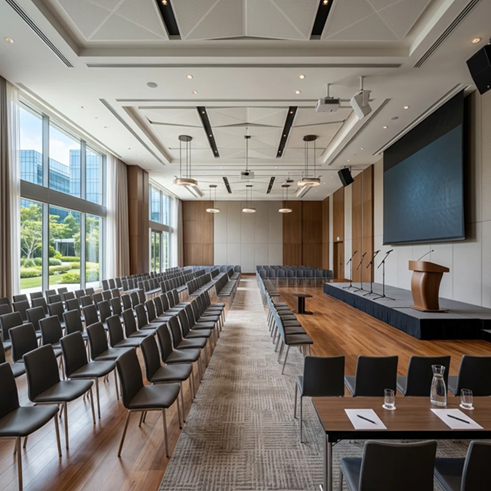
- Visual Assessment of the Space: Evaluating the layout of chairs and tables and visualizing the flow of movement within the hall to ensure there are no obstructions that could hinder the participants.
- Measuring Ambient Noise Levels: Confirming that the location is free from external disturbances—such as nearby construction work or high-traffic roads—that could interfere with the speakers.
- Face-to-Face Negotiation: Utilizing the site visit to negotiate directly with the venue management to secure the best pricing, promotional offers, or additional amenities not explicitly listed in their standard packages.
Drafting Contracts and Formally Documenting Agreements
Once the most suitable venue—one that meets all the established criteria—has been selected, the process must immediately move to the stage of legal and contractual documentation. This ensures the protection of all parties’ rights and helps prevent any potential misunderstandings in the near future.
- Detailing Financial Terms: Clearly state the total price, specify any applicable taxes or additional fees, and outline a payment schedule linked to project milestones or the date of the event.
- Defining Responsibilities: Clearly identify which party is responsible for providing any additional equipment, and establish penalties or contractual terms in the event of a cancellation or delay by either party.
- Usage Schedule: Specify the exact hours for the venue rental, including time allocated for setting up the space before the seminar begins and for vacating the premises afterward.
Conclusion
Selecting a venue for an upcoming seminar is more than just a routine task; it is a genuine investment in the success of the event and the reputation of the organizing institution. Through early planning, careful consideration of the target audience and budget, and thorough on-site and technical inspections, one can secure the ideal venue—a space that provides the perfect environment to convey the intended message and achieve desired objectives with high efficiency and professionalism.


Comments