
Key Trends in Smart Exhibition Technology for 2027
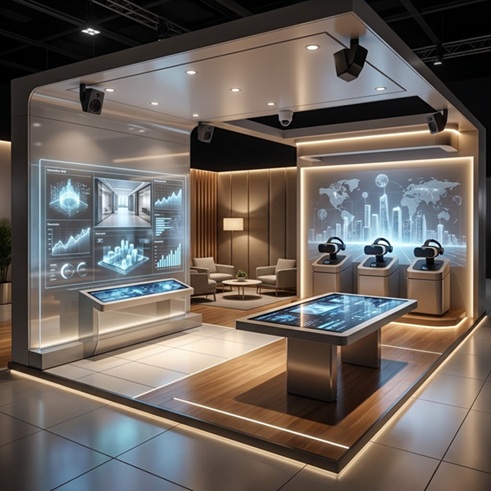
Key Trends in Smart Exhibition Technology for 2027
The global landscape of trade shows and conferences has shifted from traditional display spaces—characterized by printed materials—to interactive, digital environments powered by artificial intelligence and spatial technologies. For major corporations and banks, a strong first impression is no longer defined solely by the opulence of a booth’s structural design; rather, it is measured by the booth’s ability to deliver an immersive experience—one that transforms a casual visitor into a high-quality potential lead in a matter of seconds.
Looking ahead to 2027, business sectors are moving beyond conventional marketing methods, adopting smart ecosystems designed to multiply return on investment (ROI) and provide high-precision support for investment decision-making.
The Spatial Revolution: Virtual Reality (VR) and Extended Reality (XR) in Large-Scale Exhibitions
Virtual Reality (VR) and Extended Reality (XR) technologies represent a fundamental turning point for companies and banks that offer products or services difficult to showcase within the limited confines of an exhibition space—such as massive real estate developments, heavy industrial equipment, or digital banking branch concepts envisioned for 2027.
- Direct Digital Experience: Executives and department heads can now take visitors on high-definition, 3D virtual tours of company facilities or future projects—all without the visitor ever having to leave the exhibition booth.
- Eliminating Space and Logistical Constraints: Reducing the logistical costs associated with transporting samples and bulky equipment by shifting toward a scalable, interactive virtual environment that can be deployed across multiple exhibitions.
- Tailored Presentations: Customizing the experience for each visitor based on their specific interests—such as showcasing mortgage financing options for individual clients, or presenting cloud-based financial solutions for corporate entities—all within the same virtual reality headset.
Interactive Displays and Transparent Walls (Transparent OLED & Interactive Walls)
In smart exhibition booths, displays have evolved from simple tools for playing looped videos into interactive exploration platforms that give visitors a sense of control over how information is presented.
- Transparent Displays and 3D Objects: Transparent OLEDs allow for the overlay of digital data and advanced performance metrics directly onto physical products or models placed behind the screen, creating an innovative visual fusion.
- Multi-Touch Interactive Walls: These enable sales teams to discuss investment or financial solutions with multiple visitors simultaneously on a single screen, with the added capability to instantly send files and catalogs to a client’s email with just one click.
AI-Powered Automated Lead Capture
Inefficiency in collecting and storing data has become a significant challenge for organizations and banks participating in trade exhibitions. The solution for 2027 relies on full automation to enhance the precision of the marketing environment:
- Smart Scanning and Direct CRM Integration: Replacing paper business cards with advanced digital scanners or mobile apps that automatically capture data and instantly categorize the client based on their level of interest and the type of service required.
- AI-Powered Conversation Scoring: Tools that leverage artificial intelligence to evaluate the quality of interactions within the booth and identify a client’s purchasing intent, thereby accelerating the follow-up process after the exhibition concludes.
- Adaptive Interactive Forms: Short, intelligent questionnaires that dynamically adjust their questions based on the visitor’s responses, pinpointing their specific needs in under 30 seconds.
Spatial Analytics and Computer Vision
Smart camera technology, powered by computer vision, provides marketing managers and decision-makers with a comprehensive analytical view of visitor behavior within an exhibition booth:
- Heatmaps: Identifying the areas within the booth that attract the most visitors, as well as the time spent in front of each product or interactive display.
- Measuring Engagement Rates: Tracking peak times and high-traffic zones to help efficiently reallocate sales and hospitality staff within the designated space.
- Real-time Dashboards: Advanced control panels that provide executive leadership with instant statistics—such as visitor counts, conversion rates (visitors to potential leads), and the extent to which the exhibition booth is meeting its strategic objectives throughout the event.
Directional Audio & Spatial Sound
Large-scale exhibitions often suffer from high levels of ambient noise, which hinders effective communication between company representatives and prospective clients. Audio technologies available by 2027 offer a precise engineering solution:
- Directional Speakers: A technology that focuses sound onto a very specific, localized area within the booth. A visitor standing in front of a screen can hear the presentation with perfect clarity, while the sound fades away just a few steps later—ensuring a quiet environment and maintaining the privacy of discussions.
- Digitally Isolated Discussion Zones: The use of smart sound-insulation solutions, complemented by comfortable, ambient lighting, provides VIPs and business professionals with an ideal environment for finalizing deals and signing contracts.
Implementation Strategy for Decision-Makers in Banks and Large Institutions
To maximize investment returns and ensure that these technological solutions evolve from mere visual displays into drivers of organizational growth within a 2027 exhibition booth, a comprehensive, three-phase methodology is recommended:
Pre-Exhibition Phase (Structural Integration and Technical Readiness):
This phase requires close collaboration and direct coordination between the marketing, IT, and sales departments, with the goal of fully integrating the booth’s interactive infrastructure with the organization’s Customer Relationship Management (CRM) systems and databases. This automated integration ensures the seamless flow of data from target customers the moment it is captured, allowing for their classification based on priority and the scale of the potential investment opportunity—all while eliminating human error and preventing the loss of leads. Furthermore, this phase includes training booth staff on how to operate the technologies and manage intelligent interaction scenarios, particularly when engaging with VIPs.
During the Exhibition (Interactive Engagement and Creating a First Impression):
Throughout the exhibition, the focus shifts to operating and guiding immersive experience technologies (VR/AR) and transparent interactive displays to curate a personalized exploratory journey for each visitor. This approach is designed to capture the attention of decision-makers and high-profile guests, directly contributing to an increase in “dwell time”—the duration a visitor spends within the pavilion—while presenting complex information in a simplified, highly engaging manner. This leaves clients with a sophisticated impression, reflecting the organization’s high level of digital readiness and its capacity to lead innovation within its sector.
Post-Exhibition (Strategic Analysis and Opportunity Conversion):
This phase centers on leveraging big data and compiling spatial heatmaps to analyze visitor behavior, identifying the areas and tools within the pavilion that generated the most interest. Concurrently, the sales and corporate development team initiates immediate, personalized follow-ups with potential clients, based on the records of their digital interactions within the booth. This rapid response ensures that initial digital interest is converted into concrete investment deals—tangible contracts that multiply the final return on investment (ROI).
Related article: Integrating Technology into Sports Events
Conclusion
Smart exhibitions in 2027 serve as a strategic enabler, blending corporate sophistication with digital precision. Participation in major exhibitions and conferences is no longer merely a traditional marketing presence; it has evolved into a genuine investment, measured by conversion rates and the quality of the partnerships generated. The integration of virtual reality (VR) technologies, interactive displays, and AI-driven data automation systems redefines the visitor experience, granting institutions and banks a competitive edge in attracting major investors. In this evolving landscape, technology within exhibition pavilions transcends its role as a mere visual tool, becoming a primary driver for creating sustainable investment opportunities and forging significant economic partnerships.


Comments