
Managing Food and Hospitality for Delegations
Managing Food and Hospitality for Delegations
Food and hospitality may seem like minor details when planning a delegation visit, yet they are among the most significant factors influencing the guests’ experience and their impression of the organizing entity. Selecting the right hotel or arranging meetings is not enough to ensure a successful visit; delegations require comprehensive care throughout their stay—covering meals, beverages, dining schedules, privacy, and the handling of any special requirements.
The importance of managing food and hospitality is heightened when dealing with business, government, or official delegations visiting the Kingdom of Saudi Arabia—particularly when the visit involves high-profile figures, spans several days, or includes a packed itinerary of meetings, tours, and work programs. In such cases, organizing food and hospitality becomes an integral part of managing the delegation’s program, rather than merely an ancillary service.
Read also: The Importance of Properly Welcoming Delegations
Understanding Delegation Needs Before Arrival
Successful food and hospitality management begins well before the delegation arrives. It is difficult to provide quality service if the organizing entity is unfamiliar with the guests’ backgrounds, dietary preferences, and the visit’s daily schedule.
Therefore, it is essential to gather key information in advance, such as the size of the delegation, the approximate ages and nationalities of its members, the nature of their work, the duration of their stay, and the timing of meetings and travel. It is also crucial to determine whether any guests have food allergies or follow specific dietary regimens. Some guests may require vegetarian meals, low-calorie options, or dishes free from specific ingredients. Attention must also be paid to food allergies; managing them requires precision rather than guesswork, and the hotel and restaurant must be clearly informed of any allergies before the meal is served.
When hosting international delegations, it is also important to respect guests’ dietary and cultural habits while maintaining the character of local hospitality—reflecting Saudi culture in a sophisticated, understated manner.
Careful Selection of Dining Venues
Choosing the right restaurant involves more than just food quality; the venue itself must align with the nature of the delegation and the purpose of the visit.
For instance, a quiet restaurant with a private room is often more suitable for a business meeting or formal lunch than a bustling one, even if both offer comparable culinary standards. Conversely, if the goal is to introduce guests to local culture, one might select a venue serving Saudi cuisine in an atmosphere that reflects local heritage and hospitality.
The restaurant’s location relative to the hotel and meeting venues must also be considered. Traveling a long distance for a meal can disrupt the delegation’s schedule, particularly on days packed with meetings and fixed appointments.
It is also advisable to have backup options ready in case of sudden schedule changes or an inability to visit the originally selected venue.
Aligning Meals with the Daily Schedule
A common mistake is treating delegation meals as separate events detached from the rest of the itinerary. In reality, meals should be integrated into the visit’s daily schedule. If the delegation has a long morning meeting, it is best to schedule lunch at a location close to the meeting venue. For field trips or visits to sites outside the city, dining options during the journey should be planned in advance.
Meal times should not place undue pressure on the delegation or force them to rush from one meeting to the next. Guests require sufficient time to eat and rest, particularly during multi-day visits. In some instances—especially with back-to-back meetings—serving light snacks or beverages during the session is more practical than organizing a full meal.
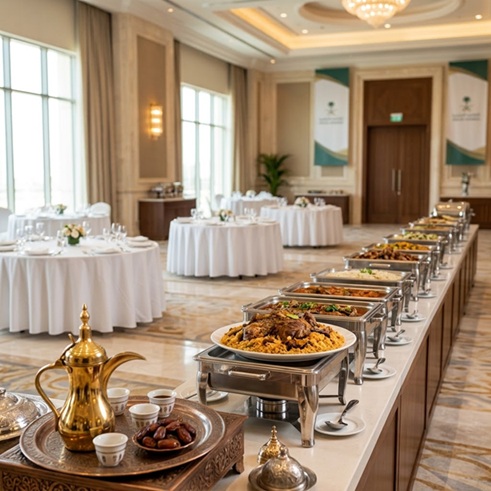
A featured article outlining catering services for high-level delegations.
Hospitality at the Hotel
True hospitality begins at the delegation’s accommodation. Therefore, it is essential to ensure the hotel is informed about the nature of the guests and their specific requirements prior to their arrival.
Arrangements can be made for a proper welcome upon arrival, ensuring rooms are ready on time and stocked with water, beverages, and other essentials tailored to the delegation’s needs. If a VIP or head of delegation is present, their room may require special arrangements befitting the level of hospitality.
Coordination with the hotel regarding breakfast arrangements—whether served in the main restaurant, in-room, or in a private area—is also important. If the itinerary begins early, the delegation may require an early breakfast or meals prepared for them to take along upon departure. Such details save significant time and prevent confusion at the start of the day.
Presenting Saudi Hospitality Appropriately
Saudi hospitality is distinguished by its unique elements, which can form a significant part of the delegation’s experience—particularly for guests visiting from abroad. Serving Saudi coffee and dates, for instance, can be part of welcoming guests or initiating meetings; local delicacies may also be served in an elegant manner suited to the occasion.
However, the most important aspect is that the hospitality remains balanced. The goal is not to offer the greatest number of items, but rather to provide a well-organized, refined experience that makes the guest feel valued.
Careful attention must also be paid to the timing of service—whether coffee, beverages, or food—particularly during formal meetings, ensuring that the hospitality does not interrupt discussions or distract attendees.
Handling Special Events and Meetings
Some delegations visit not only for business meetings but also to participate in dinners, formal events, or gatherings with officials and business leaders. In such cases, the food becomes part of the event’s overall image. Formal dinners require advance coordination regarding the number of guests, seating arrangements, menu selection, service style, and the timing of each phase of the event.
For small gatherings, a special meal or dinner in a more intimate setting may be preferable to a large-scale event. For larger events, however, it is essential to ensure the venue can accommodate the required number of guests without compromising the quality of the experience.
Attention to Specific Details
Guest needs vary from person to person; consequently, personal details can be more significant than grand gestures. A guest might prefer a specific type of beverage, require a snack at a particular time, or have dietary restrictions. Another might value greater privacy while dining.
It is important to record these details in the delegation’s program file and share them only with those responsible for service delivery. This ensures that operations do not rely on memory or personal discretion alone. Guest information—particularly regarding dietary habits or personal requirements—must be handled with respect and confidentiality.
Coordination Between Hospitality and Transportation Teams
While catering and transportation may seem like separate matters, they are directly linked. Booking a restaurant far from the hotel or meeting venue without accounting for travel time could cause the delegation to miss their next scheduled engagement.
Therefore, continuous coordination is required between the hospitality manager, the transportation manager, and the program coordinator. Key factors to consider include the delegation’s departure time, estimated arrival time, the appropriate duration for the meal, and the next item on the agenda.
For long journeys, meals or snacks can be prepared in advance, eliminating the need to find a suitable restaurant en route.
Managing Unexpected Changes
Even the best-planned programs are subject to change. A meeting might be delayed, a visit cancelled, a delegation might wish to extend an event, or a guest might request a change of meal. This is where the importance of a contingency plan becomes evident. The organizing entity must have alternative options for restaurants, hotels, and catering services, and maintain rapid, clear communication with suppliers.
Most importantly, the delegation should feel that any changes were handled seamlessly. Guests need not be aware of the challenges faced behind the scenes; they should see only the final result.
Selecting a Team Familiar with Delegations
Successful hospitality relies not only on the food but also on the people providing the service. Therefore, it is best to work with a team experienced in hosting delegations and official visits.
Staff members interacting with a business delegation must know how to communicate respectfully, maintain confidentiality, manage changes, and understand cultural differences.
There must also be a clear point of contact—someone the head of the delegation or their accompanying staff can turn to when needed—rather than forcing the guest to search for the person in charge every time an issue arises.
Hospitality as Part of the Organizer’s Image
Ultimately, guests remember more than just the food; they remember how they were treated throughout the visit. Were schedules well-organized? Were meals served on time? Were their needs accommodated? Did they receive a prompt response whenever they needed something?
For this reason, food and hospitality management should be viewed as an integral part of managing the delegation’s entire experience. Successful hospitality is not about extravagance in dining or selecting the most expensive restaurants; rather, it entails careful planning, understanding guests’ needs, respecting their time, and providing appropriate food at the right place and time.
When these elements are seamlessly integrated with accommodation, transportation, meetings, and tours, the delegation’s visit becomes more comfortable and organized. Consequently, guests leave with a positive impression of both the host organization and the Kingdom—viewing the latter as a destination capable of welcoming delegations and managing their visits with a level of professionalism befitting the nature of such engagements.


Comments