
Sound Engineering in Events
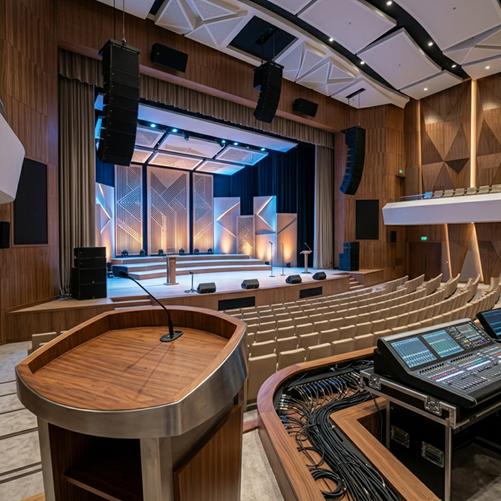
Sound Engineering in Events: A Comprehensive Guide to Technical Management and Overcoming Field Challenges
The Kingdom of Saudi Arabia is witnessing an unprecedented boom in the events and conferences industry, with Saudi cities transforming into global destinations hosting major international gatherings, political summits, economic forums, and cultural festivals. This rapid development, embodying the goals of Vision 2030, has shifted organizational standards from mere logistical efforts to a stage of “integrated engineering” that attends to the smallest details to deliver an experience befitting the Kingdom’s leading position. At the heart of this complex system, technical equipment emerges as a decisive factor between resounding success and failure. The success of any event is no longer measured solely by the grandeur of the venue or the number of attendees, but rather by the seamless flow of information and the effective delivery of communication messages to the target audience.
Organizing an event is akin to building a living entity, whose components work together to perform a specific function. If visuals are the face of an event, then sound is undoubtedly its vibrant voice and the very soul that imbues the content with value and meaning. With rising expectations from both local and international attendees, organizers and event management companies must deepen their understanding of critical technical elements, especially sound engineering. Sound is not merely a means of communication; it is the tool that ensures audience engagement. Any minor flaw in this element can undermine months of planning, making the study of sound problems and their solutions an indispensable professional necessity for anyone seeking leadership in this vital sector.
The Importance of Sound in the Success of Major Events
Sound engineering is the most subtle and impactful element in the events industry. While decorations and lighting attract attention, sound remains the primary channel for conveying knowledge and emotions. In the context of conferences and seminars held in Saudi Arabia, where events are characterized by luxury and high-level attendance, errors in the sound system are absolutely unacceptable. Sound quality does not simply mean “loud,” but rather “crystal clear,” which prevents mental strain for the listener. When attendees have to exert effort to understand the words, they gradually lose focus, leading to the failure of the event’s strategic objectives. Furthermore, sound plays a psychological role in creating the event’s atmosphere; carefully chosen background music and a balance between amplifying natural sounds convey an impression of professionalism and confidence in the organizers.
Modern Audio Equipment: From Microphones to Speaker Arrays
Corporate events and scientific seminars require a sophisticated array of equipment, which must be selected based on a thorough analysis of the venue’s size and the number of attendees:
Advanced Microphone Systems:
- Gooseneck Microphones: These not only capture sound but must also be equipped with low-frequency filters to reduce noise from papers clinking or speaker movement.
- Lavalier & Headset Technologies: For dynamic presentations, headset microphones are preferred because they maintain a constant distance between the microphone and the speaker’s mouth, regardless of whether they turn their head, thus ensuring stable sound levels.
- Wireless Digital Microphones: With technological advancements, organizers have transitioned to digital systems that offer signal encryption to prevent eavesdropping or interference, and provide superior sound quality compared to older analog systems.
Digital Mixers:
Mixers are no longer simply devices for raising and lowering volume. They have evolved into sophisticated computers that perform equalization to eliminate harsh frequencies and compression to prevent sudden shouts in the audience’s ears. These devices also enable high-definition recording of conference proceedings through dedicated outputs.
Public Sound Distribution Systems (PA Systems):
In large venues, Line Array technology is used. This technology allows sound to be directed in narrow beams, reaching the back row with the same power and clarity as the front row, while avoiding sound reflection from the ceiling or side walls. This is an engineering challenge that requires acoustic simulation software before installation.
Read also: Comparison of Types of Sound Equipment
Analysis of Common Sound Problems and Radical Solution Strategies
Events are often subject to technical problems that can cause significant embarrassment, but handling them skillfully and professionally minimizes their impact:
- Feedback Control Dilemma: Hissing occurs when sound from the speakers is reflected back into the microphone in a loop. The solution lies not only in lowering the volume but also in using “notch filtering” to cut the specific frequency causing the hissing without affecting overall sound quality. The organizing team should also train speakers on how to position themselves behind the speakers to ensure a sound-safe zone.
- RF Interference Challenges: With the abundance of wireless devices and mobile phones in the hall, microphones may be subject to interference. A professional organizer uses a “frequency manager” that monitors the electromagnetic environment in the hall and automatically switches frequencies in case of interference, while also ensuring the use of external antennas to boost the signal and prevent sound interruptions.
- Addressing the Acoustic Characteristics of the Venue: Not all halls are acoustically optimized; Some hotels rely on marble and glass, which reflect sound randomly. This highlights the importance of expertise in installing echocatchers or using speakers with very narrow beam angles (cylindrical wavefronts) to minimize interference with reflective surfaces, thus improving speech intelligibility.
The Role of Professional Organization in Sustaining Sound Quality
Organization is not just about providing equipment; it’s about risk management and proactive processes to ensure no unpleasant surprises occur:
- The Sound Check Protocol: This protocol should include the testing was conducted under realistic conditions; a thousand people in the hall significantly alters sound absorption compared to an empty hall. Engineers test each microphone, ensure battery charge (with spare battery packs available next to the mixer), and test sound quality at the outputs for live broadcasts or simultaneous interpretation.
- Human Resources and Technical Expertise: Large events require a dedicated sound engineer for each area: a monitor engineer to ensure speakers can hear themselves clearly, and a main hall (FOH) engineer. Experience here means the ability to react calmly and swiftly. If a microphone suddenly fails, a protocol must be in place to hand over a replacement microphone in under five seconds, discreetly to the audience.
- Sound Integration with Other Elements: Coordination between the sound team and the lighting and screen teams is crucial. Large LED screens often generate electronic noise that can affect audio cables if they are not properly insulated and shielded. Field experience ensures that these details flow seamlessly.
Read also: The Importance of Renting Appropriate Event Equipment
Conclusion: Sound as a Standard for Leadership in Event Management
Event management in the Kingdom today has become a global industry demanding the highest quality standards. Sound engineering can no longer be treated as a secondary matter; it must be an integral part of logistical planning and budgeting from day one. Successfully delivering a perfect sound experience reflects the maturity and professionalism of the organizing company and underscores the importance of expertise in handling various types of events, from small workshops to major international summits. Ultimately, sound is the soul that gives an event its unique character, and a commitment to excellence in sound is the only way to ensure that the event reflects the vision and ambition of contemporary Saudi Arabia.



Comments