
Sustainability in events according to Vision 2030
Sustainability in events according to Vision 2030: practical steps to reduce waste
The Kingdom of Saudi Arabia is witnessing great activity in the exhibitions, conferences and events sector, and with each new event the need to think about its impact on the environment and resources increases. A conference that hosts hundreds of guests over days may create large amounts of waste, including literature, paintings, food, and packaging, and may consume more energy and fuel than it should. Hence, sustainability in events has become an essential element in planning any successful event, not an additional option. In this article, we present practical steps that will help you reduce waste in your events, in line with the directions of Vision 2030.
Why has sustainability become part of organizing events in the Kingdom?
Saudi Vision 2030 places environmental sustainability among its priorities, and this priority is evident in major national initiatives such as the Green Saudi Initiative, which was launched in 2021, and aims to increase the green area, reduce carbon emissions, and protect large areas of land and seas. The Kingdom also announced the goal of reaching zero emissions neutrality by 2060.
These trends are reflected in the events sector in three clear ways:
- Expectations of government agencies and large companies: These agencies are increasingly interested in partners who take into account environmental standards when choosing an event organizer.
- Expectations of international guests and delegations: Many foreign visitors care about responsible practices, and these practices are reflected in their impression of the event and the Kingdom.
- Cost efficiency: Reducing waste means reducing spending on unnecessary materials. Good sustainability often saves money.
This does not conflict with the values of hospitality that Saudi society cherishes, but rather complements them. Preserving grace and not being extravagant are two inherent values, and applying them in events expresses our culture in a modern way.
Where does waste occur at events?
Before moving on to developing practical solutions, it is necessary to identify the points from which waste usually leaks during the organization of events and conferences, as the most prominent of these sources are concentrated in the following aspects:
- Paper printouts: These include program brochures, signage, and labels that are printed in bulk and end up in the trash once the event is over.
- Food and drinks: Waste here often results from overestimating the actual attendance numbers, in addition to relying on open buffets that leave huge amounts of surplus food unconsumed.
- Decoration and platforms: These are structures, backgrounds, and designs that are tailored specifically for one event only, and then dismantled and destroyed because they are not reusable.
- Single-use containers: such as plastic water bottles, paper cups, plates and cutlery that are used once and generate a huge amount of waste.
- Transportation: Relying on sporadic and uncoordinated trips, or allocating cars and buses moving at half their capacity to transport guests and organizers.
- Energy consumption: Operating lighting and air conditioning systems at full capacity in empty halls before or after the start of the event, or setting them to settings that are not appropriate for the size of the audience.
Carefully monitoring these sources from the early planning stage gives you clearer vision for setting measurable goals, such as halving the amount of paper print through digital transformation, or reaching zero avoidable food surplus through smart hospitality management.
Practical steps to reduce waste at your events
Recording and digital materials adopted
Replace paper with an electronic registration platform and QR codes carrying the programme, maps, speaker bios and presentations. This method saves printing and allows you to update information in real time without reprinting. If printouts are necessary for some classes, print in quantities calculated based on the number actually enrolled.
Plan food carefully and handle excess responsibly
Hospitality is one of the most important elements of the success of any Saudi event, and therefore it must combine generosity and non-extravagance:
- Estimate quantities based on actual attendance at previous events, not just the number of registrants.
- Serve food in batches instead of preparing all quantities at once.
- Agree in advance with the implementing agency on how to deal with the proper surplus.
- Cooperate with associations specialized in preserving blessings, such as the Etaam Association, to deliver the good surplus to those who deserve it in accordance with approved health requirements.
Design platforms and decor for reuse
Ask the designer to use modular, demountable structures, and avoid elements associated with a single event history. Signs can be printed without mentioning the year for reuse, and choose recyclable materials instead of composite materials that are difficult to dispose of. At exhibitions, encourage exhibitors to have ready-made, reusable stands.
Reduce single-use packaging
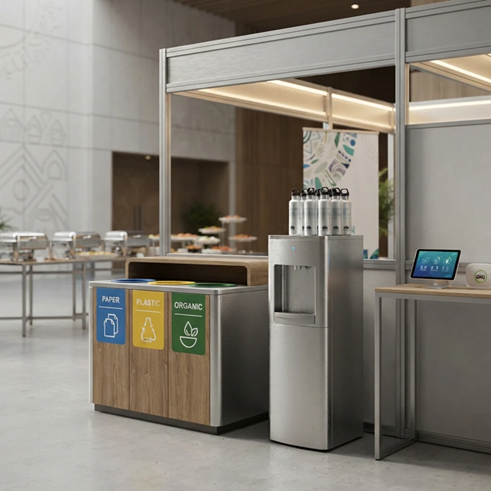
Provide chilled water refill points, reusable or biodegradable cups, and provide guests with event-branded water bottles that they can keep throughout the conference. This simple step significantly reduces plastic waste and enhances the image of effectiveness.
Organize guests’ transportation intelligently
Emissions and costs can be reduced together by:
- Group guests in buses instead of individual cars as much as possible.
- Choose hotels close to the event location to reduce distances.
- Establish coordinated transportation schedules with arrival and departure times.
- Use modern or electric vehicles where available.
However, the comfort of delegations and the prestige of the reception remain a priority, and the two matters can be reconciled with advance planning with a specialized company.
Choose local venues and suppliers
Contracting with local suppliers reduces shipping distances and supports the national economy, which is consistent with the goals of enhancing local content. When choosing an event location, prefer locations that use energy-efficient lighting and air conditioning systems, and have clear waste management policies.
Sort Waste and Recycling
Place clear, distinct bins for sorting paper, plastic, and organic waste, and ensure the team understands the sorting process before the event begins. Verify that the cleaning staff transports each waste category to its proper destination; sorting is pointless if everything ends up in the same bin.
Conserve Energy at the Venue
Use LED lighting, adjust air conditioning based on the number of attendees, and turn off equipment during long breaks. For outdoor events, leverage natural daylight as much as possible.
How Do You Measure the Success of Your Efforts?
What cannot be measured cannot be improved. Define simple indicators before the event and review them afterward, such as:
- Total weight of waste and the percentage recycled.
- Amount of surplus food and the portion that reached beneficiaries.
- Number of printed materials compared to previous events.
- Number of passengers using shuttle buses versus those arriving in individual cars.
- Document these results in a concise report to share with your client and partners. This report enhances your credibility and provides a foundation for improving future events.
Frequently Asked Questions
- Does sustainability increase event costs? Not necessarily. While some measures may require an initial investment, reducing printing and food waste, as well as reusing decor, lowers expenses in the medium term.
- Can sustainability be applied to small-scale events? Yes; steps such as relying on digital materials, accurately estimating food quantities, and minimizing packaging are suitable for events of any size.
- Where should I begin if I have never implemented sustainability practices before? Start with three key actions: digital registration, careful food planning, and reducing single-use packaging. Gradually expand these efforts with each subsequent event.
- Do international delegations care about sustainable practices? Many do—and demonstrating such commitment enhances the overall impression of your event’s organization.
Conclusion
Sustainability in events is not a massive undertaking requiring an extraordinary budget; rather, it is a series of small, strategic decisions made during the planning phase that collectively make a significant impact—such as using digital materials instead of paper, accurately estimating food quantities, reusing decor, coordinating transportation, and sourcing from local suppliers. By taking these steps, you align your event with the goals of Vision 2030, reduce costs, and leave a more positive impression on your guests.
If you are planning an event or a visit for a delegation and wish to execute it in a professional and responsible manner, AL Wofod Team is ready to handle every detail—from arrivals and transportation to accommodation and meeting facilities. Contact us today, and let us help you turn your vision into a successful event.


Comments