
The Importance of Professional Farewells for Delegations
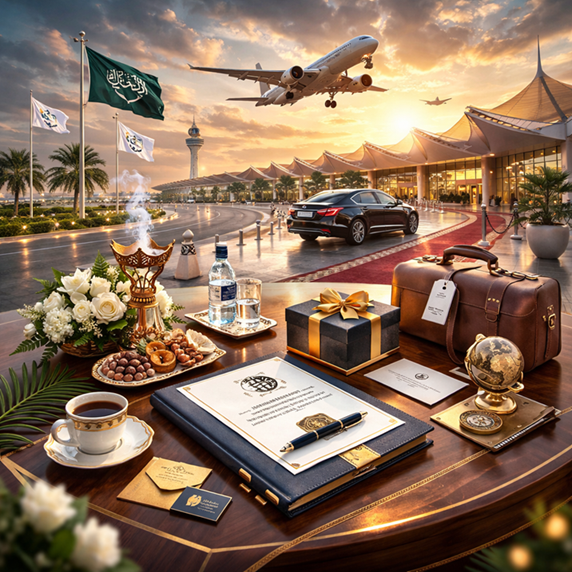
The Importance of Professional Farewells for Delegations in Fostering Sustainable Relationships
If welcoming guests is the “gateway” that opens avenues for cooperation and breaks the ice of initial encounters, then a professional farewell is the “final touch” that documents the experience and imbues it with lasting significance. In the world of international relations and business management, the quality of hospitality is measured not only by what is offered at the outset, but also by how the visit concludes. Farewells are not merely a routine procedure that ends once the guest arrives at the airport gate; rather, they are a complex strategic process aimed at transforming the visitor from a “transient guest” into a “sustainable partner” or a “positive ambassador” for the organization and the nation.
In authentic Arab and Saudi culture, generosity is linked to “completion,” meaning fulfilling the duty of hospitality from the very first moment until the guest’s departure. This extended value is what makes professional farewells a fundamental pillar in building an organization’s reputation.
First: The Psychological and Mental Dimensions of a Last Impression
Psychological studies point to what is known as the “Peak-End Rule,” a psychological phenomenon that leads people to judge an experience based on its most impactful point (the peak) and how it ended (the end).
- Establishing a Positive Memory: Any flaw in the farewell ceremony, such as a delayed bus or confusion at the airport, can overshadow the successes of meetings that lasted for days. A smooth farewell ensures that the guest’s last mental image is one of “perfection.”
- A Continued Feeling of Appreciation: When a guest sees that the attention given to them hasn’t diminished after the official business or contract signing is complete, they develop a sense of personal appreciation, building emotional loyalty to the host organization.
Second: Logistical Planning: Punctuality and Smooth Operation
Professional farewells begin “behind the scenes” at least 24 hours before departure. Here are the essential details:
Checking Travel Schedules
The dedicated team should review flight tickets and ensure there are no changes to flight times. Contacting airlines or Al Fursan Lounges (for official delegations) ensures that any delays are known in advance, preventing guests from experiencing long waits at the airport.
Bag Management
For large delegations, baggage can become a logistical burden. Professional farewells involve assigning a team to transport luggage from guest rooms to the vehicle, clearly labeling it, and verifying its weight to avoid any issues at the airport. This type of proactive service relieves guests of logistical worries.
Ideal Transportation
The farewell vehicle should be no less impressive than the arrival vehicle. Vehicles should be clean, equipped with refreshments, and have a means of quick communication. Drivers should be selected for their calm and punctual driving skills, along with a thorough knowledge of alternative routes to avoid traffic congestion.
Read also: Farewell to Various Delegations at the Airport
Third: The Protocol of “Souvenir Gifts” and Their Cultural Value
Farewell gifts are not “bribes” or “material favors,” but rather “symbolic messages.”
- Local Identity: In Saudi Arabia, it is preferable to present gifts that reflect heritage, such as fine incense, Sadu weaving, or handcrafted pieces made by Saudi artisans. These gifts act as “memory anchors,” connecting the guest to the local culture.
- Personalization: A gift bearing the guest’s name or their organization’s logo alongside the host’s logo conveys a sense of special attention.
- Farewell Kit: A thoughtful idea that includes a travel snack, a bottle of water, hand sanitizer, and perhaps a printed album of the visit’s photos.
Fourth: Formal Farewell Ceremonies (At the Airport or Headquarters)
The moment of farewell is when respect is translated into words and actions:
- Level of Representation: The person seeing the delegation off at the airport should be of an administrative rank commensurate with the importance of the delegation. Allowing the delegation to leave with only the driver is a serious protocol error, suggesting that interest ends once the business is done.
- A brief farewell message: A short message expressing pleasure at the visit, anticipation of future meetings, and an affirmation that “our doors are always open.”
- Accompanying the guest to the point of no return: In high-level protocols, the guest is accompanied to the departure lounge or, if permitted, to the aircraft door, providing a sense of security and personal attention.
Fifth: Post-Departure… “Follow-up Protocol”
A professional farewell doesn’t end with takeoff; it continues digitally:
A message of reassurance
Once the delegation arrives at its destination, a message (email or WhatsApp) should be sent to confirm their safe arrival. This simple gesture strengthens the human aspect of the relationship.
A visual final report
Send a “visit highlights” file containing professional photos and videos of the events and meetings, along with links to press coverage of the visit. This report serves as a marketing tool within the visiting delegation’s organization, as they will present it to their managers and colleagues, enhancing your reputation with them.
Conducting a tactful survey of impressions
Asking the delegation for feedback on the level of service and hospitality conveys that your organization always strives for excellence and professionalism.
Sixth: Common Mistakes in Saying Goodbye to Delegations (and How to Avoid Them)
- Rushing: Giving the guest the impression that you “want to get rid of them” or that your schedule is packed on the day of their departure.
- Neglecting the escorts: Focusing solely on the head of the delegation and ignoring other members. Remember, “Today’s secretary may be tomorrow’s manager.”
- Lack of clarity: Leaving the guest wondering about the departure time or who will be accompanying them. Continuous communication is key.
- Ignoring cultural barriers: Such as offering gifts that do not align with the guest’s cultural or religious values.
Seventh: The Impact of Professional Farewells on Saudi Vision 2030
As the Kingdom transforms into a global destination for investment, tourism, and conferences, the “art of farewell” becomes a tool of soft power. Every delegation departing the Kingdom carries with it an exceptional farewell experience, contributing to:
- Attracting foreign investment: Investors seek an environment characterized by discipline and professionalism in every detail.
- ActivatingTourism: A positive impression encourages visitors to return with their families.
- Improving the public image: Conveying the true image of the modern Saudi citizen who combines traditional values with global professionalism.
Eighth: The role of specialized companies in managing these moments
Recognizing all these complexities, major organizations turn to specialized companies like “Delegation Services” to handle this task. A specialized company possesses:
- Relationships and communication skills: To facilitate airport procedures and permits.
- Protocol expertise: To know “who is seeing whom off” and how to choose appropriate gifts.
- Crisis management capabilities: Such as handling sudden flight cancellations or lost luggage, and ensuring the guest experiences no stress.
In short: Farewells as an investment, not a cost
Professional delegation farewells are a long-term investment in human and professional relationships. It is the moment that determines whether this visit is just a “passing event” or the “beginning of a historic partnership.” When we invest time and effort in these final moments, we send the message: “We care about you as people, not just as businesses.”
The next time you receive a delegation, remember that your true success begins with the “Welcome” and is deeply cemented with the “May you be safe.”


Comments