
The Importance of Integrated Management for Delegation Visits
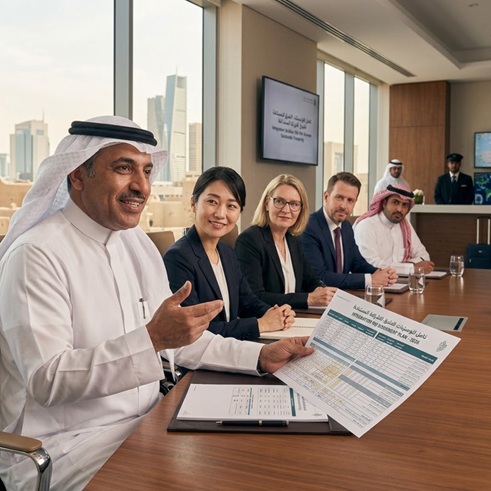
The Importance of Integrated Management for Delegation Visits
Managing a business delegation visit goes beyond merely booking hotels, vehicles, or restaurants; it is a comprehensive process requiring the coordination of all elements into a unified itinerary.
For instance, meeting times impact transit schedules, hotel locations affect travel duration, dinner times must align with the meeting agenda, and sightseeing activities must be strategically placed within the program.
Consequently, engaging a specialist firm to organize and manage delegations is a practical choice for companies wishing to focus on the commercial aspects of the visit, rather than expending time on the minutiae of logistics.
First: Logistical Harmony and Its Role in Shaping the Company’s Image
When a business delegation arrives in the host country, impressions are not formed solely within the meeting room or during presentations; they begin the moment the delegation is welcomed at the airport and during initial transfers. The host company’s image is shaped by subtle yet highly impactful details:
- Punctuality and seamless transportation: Delays or haphazard route planning do not merely reflect poor logistical planning; they send an implicit message regarding a lack of business discipline.
- Quality and suitability of accommodation: Hotel selection should not be based solely on star ratings, but also on proximity to meeting venues and scheduled activities, as well as the availability of a comfortable environment where delegates can relax and prepare for formal engagements.
- Seamless Flow Between Work and Rest: Striking a precise balance between an intensive meeting schedule and breaks demonstrates the host company’s respect for the delegation members’ time and effort, thereby creating an immediate impression of high professionalism.
Read more about managing events under pressure.
Second: The Impact of Integrated Management on Business Meeting Productivity
The primary goal of any business visit is to achieve tangible results—whether through signing contracts, establishing strategic partnerships, or exploring new investment opportunities. Integrated management plays a crucial role in supporting this objective through the following aspects:
- Minimizing Distractions and Mental Stress: When a CEO or host team is preoccupied with contacting rental agencies, managing restaurant reservations, or handling unexpected delays, their focus shifts away from core negotiation objectives. Integrated management eliminates these distractions, allowing both parties to concentrate fully on the meeting content.
- Integrated Schedule Planning: Coordinating appointments prevents conflicts. For instance, selecting a meeting location must account for peak traffic hours, while scheduling a lunch banquet requires allowing sufficient time for informal conversation without disrupting the timing of a subsequent site visit.
- Flexibility and Responsiveness to Change: Business meetings are subject to rapid adjustments; a critical meeting might run longer than anticipated, or the delegation might request changes to the itinerary. Integrated management enables the immediate rescheduling of the day’s remaining activities without compromising the quality of the visit.
Third: The Cultural and Tourism Dimension as a Tool for Building Long-Term Partnerships
Business visits are no longer confined to the four walls of meeting rooms. Integrating cultural and tourism experiences into a delegation’s itinerary is a crucial element in fostering the human connections that underpin sustainable partnerships:
- Highlighting Cultural and Local Identity: Visits to key historical and cultural landmarks—such as Diriyah, AlUla, or Saudi Arabia’s heritage districts—provide delegation members with a deeper understanding of the investment environment and the region’s history, thereby building bridges of mutual appreciation.
- Breaking the Ice and Fostering Personal Relationships: Off-site banquets and tourism activities create opportunities for open, informal dialogue, allowing for the development of genuine trust that is often difficult to establish at formal negotiation tables.
- Strategic Timing of Activities: Leisure and cultural activities should be scheduled intelligently—for instance, following a series of demanding meetings—to serve as a refreshing interlude that leaves guests with a positive and enjoyable final impression.
Fourth: Comparison Between Traditional Organization and Integrated Management of Business Delegations
Fundamental differences exist between the traditional organizational approach and the integrated management of delegations across several key areas:
- Task and Service Management Mechanisms: In traditional organization, efforts are often fragmented due to dealing with multiple parties and service providers individually and separately (such as independently coordinating with hotels, transport companies, and restaurants). In contrast, integrated management provides a single, unified point of contact that organizes and coordinates all operations and services under one umbrella.
- Flexibility and Emergency Handling: Traditional organization often leads to confusion and scheduling conflicts whenever there is a sudden change or emergency regarding the itinerary. In contrast, integrated management offers high flexibility and the ability to seamlessly reschedule all activities and logistics on the fly, without disrupting the flow of the visit.
- Host Team Focus: The traditional model often drains the host team’s time and effort as they attend to minute logistical details and daily coordination tasks. The integrated management model, however, frees up the host team entirely, allowing them to dedicate their full energy to achieving business objectives and building strategic relationships.
- Visiting Delegation Experience: Under traditional organization, the visiting delegation may perceive a lack of cohesion or disjointedness between their movements and field meetings. Integrated management, conversely, ensures a seamless, comprehensive experience that leaves guests with an impression of the highest levels of professionalism and organization.
- Return on Investment (ROI): Traditional organization carries a high risk of missing business opportunities due to poor planning or logistical setbacks. Integrated management, however, helps maximize ROI by creating an excellent impression that paves the way for better outcomes and mutual understanding.
Fifth: An Action Plan for Organizing a Successful Trade Delegation Visit
To implement integrated delegation management effectively, a systematic approach can be followed—starting before the delegation arrives and continuing after their departure:
Pre-Arrival Phase (Planning and Preparation):
- Defining the visit’s primary objective, the nature of the delegation, and any specific requirements.
- Developing a flexible schedule that coordinates meetings with accommodation and transportation logistics.
- Pre-arranging protocols and official reception procedures.
Execution Phase (During the Visit):
- Managing logistics in real-time to ensure adherence to the schedule.
- Providing continuous technical and logistical support to both the host team and the delegation.
- Balancing the work agenda with cultural and social activities.
Post-Visit Phase (Follow-up and Evaluation):
- Gathering impressions and feedback from both the visiting delegation and the host team.
- Following up on meeting outcomes and resulting recommendations.
- Documenting the visit experience to serve as a reference for future visits.
Read also: How to Choose the Right Exhibition Organizing Company
Conclusion
In today’s business world, logistical details are no longer a mere footnote on the agenda; they have become a pivotal element that directly contributes to the success or failure of a deal. A holistic view of a delegation’s visit transforms every stage—from the airport arrival and meeting sessions to the final banquet—into a genuine opportunity to demonstrate professionalism and readiness.
Investing in the comprehensive management of business delegation visits reflects the host company’s commitment to excellence and its ability to efficiently manage complex projects. Through meticulous coordination, on-the-ground flexibility, and sensitivity to cultural and human nuances, companies elevate these visits from mere logistics and appointments into pivotal milestones that lay the foundation for successful, sustainable business partnerships.
Crafting a comprehensive itinerary for a business delegation visiting Saudi Arabia for the first time begins with understanding the visit’s objectives and culminates in delivering a well-organized, comfortable experience for the guests. The more precise the planning, the more productive the meetings, the smoother the transportation, and the more comfortable the accommodation; furthermore, the tourism and cultural aspects become positive highlights of the visit.
Crucially, the delegation’s journey should be viewed as a single, integrated experience rather than a collection of disjointed bookings. When meetings, accommodation, transportation, dining, and sightseeing are seamlessly aligned, the host company can deliver a professional experience that reflects its high standards and fosters stronger, long-lasting business relationships.


Comments