
Stages of Planning Your Next Outdoor Seminar
Stages of Planning Your Next Outdoor Seminar
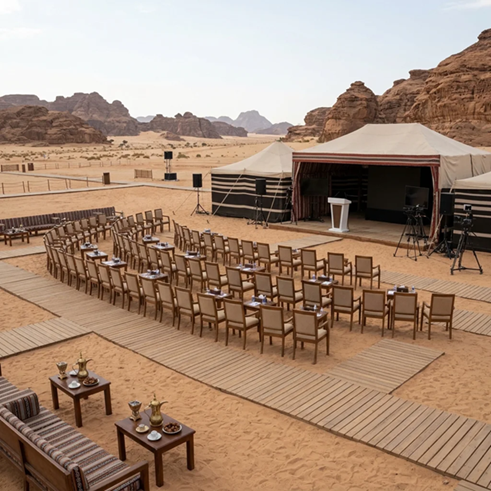
Seminars are no longer confined to the walls of hotel conference rooms. Given the diverse landscape of the Kingdom—ranging from deserts and oases to coastlines and mountains—event organizers are increasingly turning to open-air spaces. These settings lend a unique identity to an event, creating a memorable experience for attendees. However, an outdoor seminar requires a different approach than one held indoors; factors such as weather, acoustics, lighting, and safety demand more precise planning and extensive coordination. This article explores the key advantages of hosting seminars in open-air settings, provides examples from within the Kingdom, and outlines the practical stages for planning your next outdoor seminar.
Key Advantages of Hosting Seminars in Open-Air Settings
- A Memorable, Distinctive Experience: Being seated under an open sky or amidst sand dunes and mountains creates an impression that standard conference halls cannot replicate, thereby enhancing the perceived value of the seminar for both participants and speakers.
- An Environment Conducive to Dialogue: In open-air settings, people tend to feel more relaxed and open, making informal discussions and networking easier and more spontaneous.
- Flexibility in Space and Design: Unconstrained by walls or fixed seating arrangements, you have the freedom to design a main stage, breakout discussion areas, hospitality zones, and exhibition spaces tailored specifically to your program’s needs.
- Thematic Alignment with the Venue: Seminars focused on topics such as the environment, heritage, agriculture, or renewable energy gain greater credibility and impact when held in a location relevant to the subject matter—an experience that can be further enriched by incorporating a field tour.
- Rich Marketing Content: Natural landscapes provide organizers with compelling imagery and footage, which can be leveraged for media campaigns to boost the event’s reach and visibility.
- Natural ventilation and space for social distancing: Open-air venues allow for a more comfortable distribution of attendees compared to crowded, enclosed halls.
Read also: What are the different types of seminars?
Examples of open-air, nature-integrated events in the Kingdom
AlUla Governorate stands out as a premier destination for hosting intellectual gatherings set amidst nature and heritage. Documented examples include:
The Hegra Conference (for Nobel Laureates and their guests)
Held in AlUla over three days, the second edition of this conference in 2022 hosted approximately 35 Nobel Laureates from the fields of peace, economics, literature, science, and medicine. The event took place at the Maraya center, which features an 800-square-meter retractable window that opens the hall to the surrounding natural landscape. Guests also participated in cultural tours, including visits to World Heritage sites and the “Desert X AlUla” open-air art exhibition. Local resorts, such as “Caravans by Habitas,” offer luxury camping sites nestled among sandstone mountains that can be adapted for open-air events.
The AlUla World Archaeology Summit
Organized by the Royal Commission for AlUla, the inaugural edition of this summit took place in September 2023, followed by the 2024 edition on October 30–31. The program combined formal sessions and discussions with field visits to the region’s archaeological sites.
It is worth noting that many of these events employ a hybrid model: hosting core sessions in a formal indoor venue, while organizing activities, tours, and hospitality offerings in the open air. This model is a smart choice for those concerned about unpredictable weather.
Stages for Planning a Successful Outdoor Seminar
Stage One: Defining the Objective and Audience
Begin by asking two questions: What do you want to achieve with the seminar? And who will be attending? An audience of senior officials, for instance, requires a different level of comfort and service than an audience of students or young people. Your objective will determine the venue capacity, the nature of the program, and the event budget.
Stage Two: Selecting the Season and Date
This is the most critical decision for outdoor seminars. In Riyadh, Jeddah, and many other cities across the Kingdom, the best time for outdoor activities is between November and March, when the weather is mild. Conversely, during the summer months, extreme heat makes open-air spaces unsuitable—often rendering many locations unusable during the day. Schedule your event during the milder season, and be mindful of religious and academic calendars, as well as other major events that might strain the availability of hotels, venues, and service providers.
Stage Three: Choosing the Venue and Conducting a Site Visit
Do not rely solely on photographs; visit the site at the same time of day as the planned seminar. Pay attention to the position of the sun and shadows, wind direction, ambient noise levels, the condition of the ground, accessibility, parking availability, proximity to hospitals and emergency services, and the strength of mobile and internet coverage.
Stage Four: Permits and Relevant Authorities
Identify the owner or operator of the venue early on, and determine the permits required to host the event. This may involve local municipalities, regional authorities, or the governing body overseeing the area, in addition to meeting Civil Defense requirements and safety regulations. If the venue is a nature reserve or a heritage site, additional restrictions may apply regarding installations, lighting, and the number of attendees. Begin this phase well in advance, as some permits may take time to secure.
Stage Five: Setting Up Operational Infrastructure
An open-air venue often starts from scratch, so ensure your checklist includes:
- Shade and Shelters: Tents or canopies to provide protection from the sun, rain, or dust.
- Climate Control: Misting fans or outdoor air conditioning for the summer, and heaters for cold evenings in the winter.
- Electricity: Primary and backup generators, along with safe electrical wiring.
- Sound: Audio systems capable of withstanding wind and covering the entire space without distortion.
- Lighting: Essential for evening sessions and for ensuring safety along pathways.
- Internet and Broadcasting: Redundant connections if the event is being live-streamed.
- Facilities: Adequate restrooms, a prayer space, a hospitality area, and clear signage.
Stage Six: Health, Safety, and Emergency Planning
Develop a written plan that includes a medical/first-aid team, hydration stations, evacuation routes, emergency contact numbers, and a designated safety officer. Also, prepare a contingency plan for adverse weather—such as relocating to an indoor hall or an enclosed tent in the event of dust, rain, or strong winds—and pre-determine who has the authority to trigger this plan and under what conditions.
Stage Seven: Program and Content Design
Keep sessions in open-air settings relatively short, as attendees tend to tire more quickly; incorporate frequent breaks for rest and refreshments. Schedule the most important sessions for the times of day with the most favorable temperature and lighting conditions, and make the most of the venue by including a guided tour or a discussion session in a unique spot. If there are multiple sessions, ensure that the distance between the various stages or platforms remains short.
Stage Eight: Marketing, Registration, and Transportation
Inform participants about everything related to the venue: appropriate attire, the nature of the terrain, weather forecasts, and details regarding drop-off points and parking. If the venue is remote, provide organized transportation from hotels and designate specific parking areas. Send a reminder one or two days before the event, including an update on the weather and any changes to the plan.
Stage Nine: Execution and Evaluation
Conduct a full technical rehearsal at least one day before the event. Ensure every team member has a clearly defined role and a communication device. After the seminar, distribute a brief survey, and review what went well and what did not, in order to improve future events.
Common Mistakes to Avoid
- Scheduling an event during a hot season without a cooling plan: Temperatures vary across the Kingdom’s cities and seasons; midday sessions in the summer can become an exhausting experience for both attendees and speakers. If you must schedule an event during a hot period, move the sessions to early morning or late afternoon. Provide shade, misting fans, outdoor air conditioning units, and cold water stations. Ensure that cooling costs are included in the budget from the outset—not after contracts have already been signed.
- Neglecting a contingency plan for weather: Sudden dust storms, rain, or strong winds can disrupt sessions at any moment and may damage audio equipment and screens. Prepare a nearby hall or an enclosed tent capable of accommodating all attendees. Determine in advance who has the authority to decide on a relocation and when such a decision should be made; ensure that both speakers and attendees are informed of this contingency plan before the day of the event.
- Minimize electrical and audio requirements for open-air settings: Unlike indoor halls, outdoor spaces lack walls to contain sound and readily available power sources. Furthermore, wind and ambient noise can diminish the clarity of speech. Calculate the electrical load required for lighting, cooling, and screens; secure backup generators; select sound systems suitable for open spaces; and test them from the rearmost seats before the event begins.
- Do not overlook essential facilities such as prayer rooms, restrooms, and shaded areas: Attendees require a clearly marked, accessible prayer space (with reminders for prayer times), a sufficient number of clean restrooms, and shaded areas for waiting or resting. The absence of any of these can leave a negative impression, regardless of how compelling the seminar’s content may be. Use clear signage to direct attendees to these facilities.
- Avoid delays in obtaining permits: Certain locations—particularly natural sites or heritage landmarks—may require approvals from multiple authorities, a process that often takes longer than anticipated. Begin the application process well in advance of the event. Prepare a site map, confirm the expected number of attendees, compile a list of temporary installations, and inquire early with the site owners about safety and civil defense requirements.
Read also: How to Choose a Venue for Your Next Seminar
Conclusion
An outdoor seminar offers a unique opportunity to create a distinctive event, but its success depends entirely on the precision of the planning. Choose a season with mild weather, inspect the venue yourself, prepare the operational infrastructure and a contingency plan, and design a program that prioritizes the comfort of attendees. If you are concerned about unpredictable weather, a hybrid setup—combining an indoor, climate-controlled space with an open-air area—offers the best of both worlds.


Comments